


A lot of it boils down to how vampire you’re willing to be.
When you travel to a new time zone, you can adopt the lighting habits of the people there right away—this is called slam shifting—and you will eventually adjust. You can get up at your normal wake-up time (shifted to local time), blast yourself with light all morning, force yourself to stay awake all afternoon, pass out at your normal (shifted) bedtime, then get up and do the same thing all over again the next day. It might be brutal; it might not adjust you before the end of your vacation; but slam shifting does eventually get you to that new time zone if you give it long enough.
This is not usually how best to get over jet lag, but it’s also not strange. To everyone around you in the airport, everyone walking by you in the streets of Milan, you will look normal.
Let’s entertain, then, the idea that avoiding foggy middays and middle-of-night awakenings might warrant a little strangeness. What kind of strangeness are we talking about?
Well, light’s the most important signal for helping shift your body’s clock, so it’s being strange about light. Generally speaking, you can adjust faster to a new time zone if you embrace a bit of vampire life.
History lesson
Back in 2014, I made a jet lag app called Entrain which got a lot of downloads. Entrain recommended schedules to get over jet lag that adjusted (or “entrained”) a mathematical model of the human circadian clock as quickly as possible. The conventional wisdom is that it takes about a day per hour you’re shifting to get over jet lag; the schedules in Entrain achieved shifts about three times faster than that.
There was an issue, though: the schedules in Entrain had a lot of darkness. For some people and some trips, the darkness was no big deal. For others: well, famously, the “go from New York to Los Angeles” 3-hour shift schedule in Entrain had people avoiding light until the Pacific Time afternoon. When you go from New York to California, you’re probably not looking to spend your whole morning inside, avoiding the sun—especially not for a three-hour circadian shift. For almost no one would it be worth it.
For some people, though, maybe it was! Jet lag is a very spiky design space: You will find some people who want to adjust faster, no matter what, and others who want to protect their daylight at all costs. Either one of those people, looking at the best schedule for the other, would think “wow, who on earth would WANT this?”
You can think of these preferences as existing along a continuum of “vampire willingness.” High vampire means you’ll embrace the darkness during the day (if needed) and keep the lights on at night (if needed). Low vampire means you’ll just stick to the sun, thanks. A traveler who wants to adjust to Tokyo quickly and is willing to embrace the vampire life ahead of time might have their entrainment look like this:
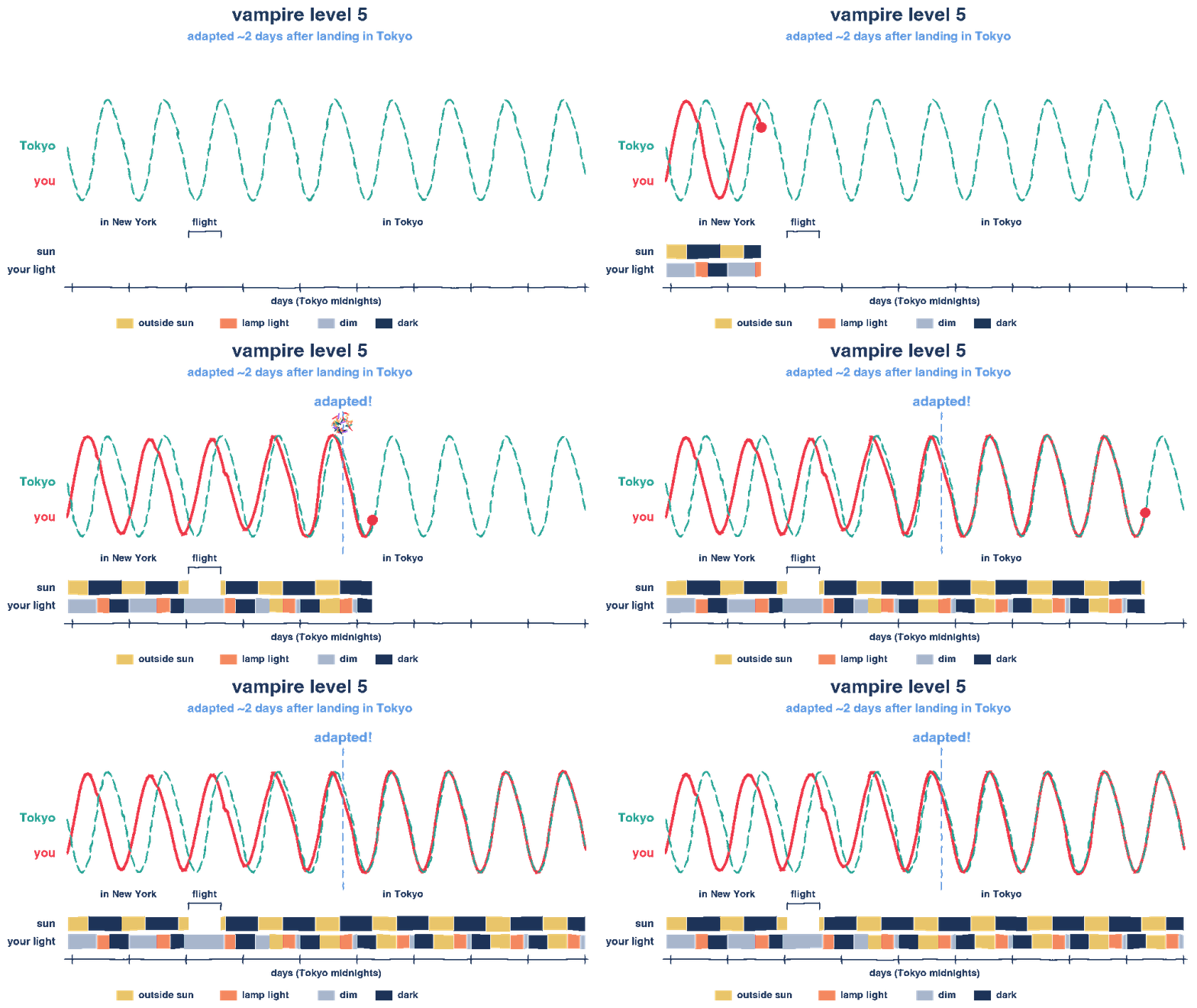
while a traveler who really doesn’t want to be that weird might look like this:
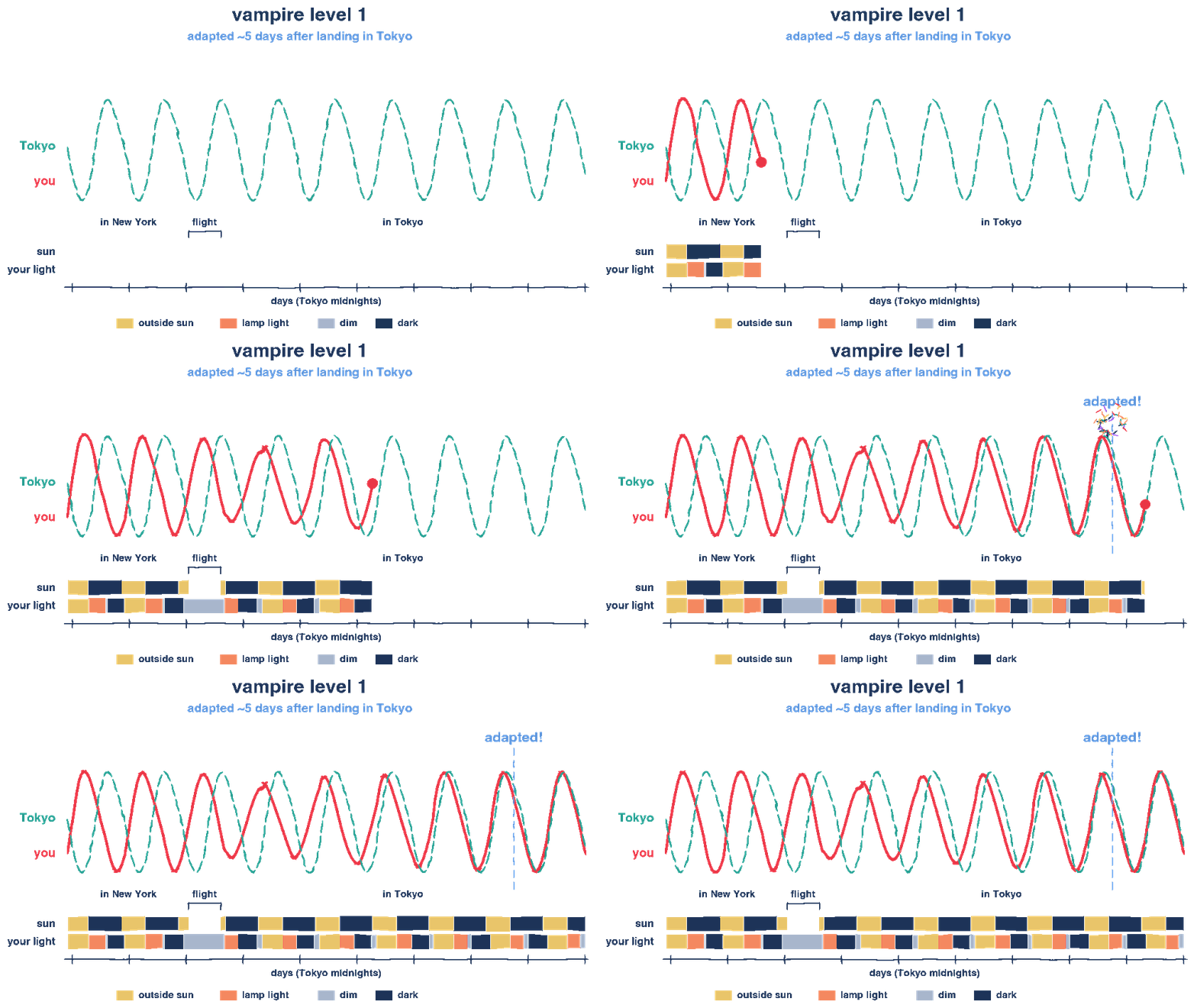
You’ll adjust slower, but you won’t be a vampire. Fair trade.
Some trips don’t require the vampire commitment
In my last blog post, I made the point that different trips need different plans because of light’s different effects on your body at different times. Some of these plans are more vampire than others!
One of the least vampirish is the 4-5-hour shift from New York to London. That’s a trip where you want to make your circadian clock earlier. If you land in London at 9 am local time, that’s just about right at the start of the time when light is going to move your clock earlier. Getting out and seeing the sun is exactly what you want to do. Seeing the sun at 9 am is a normal, daywalker thing to do.
But what about Los Angeles to Paris? At 9 am Paris time, blasting yourself with light will almost certainly push you away from, not towards, Paris time. You’ll want to be a bit of a vampire for the first few hours there, if you can tear yourself away from the fresh baguettes with curlicue smell lines and plunge into the shadows.
Where does sleep come into it?
If you’re crossing significant time zones, you’re going to lose some sleep at some point. Your circadian drive to sleep, which sets out a big comfy molecular mattress for you to sleep on once a day, can only drag that mattress to a new time zone so fast.
If you’re severely starved of sleep, you don’t need a big comfy molecular mattress to fall asleep; you can just pass out on the floor. This happens all the time in jet lag. The classic line is “well, I slept fine the first night after we landed, but the second…”
The first night you were so exhausted from the trip, you could have slept anywhere, anytime, no biological clock-driven sleep-promoting window required. The second night, you’re less utterly exhausted, and you start to realize that you’re trying to sleep on the biological equivalent of your kitchen floor. You sit up and look around. “I’m coming!” your circadian clock shouts from the other room. You peer in its direction. The mattress is stuck halfway through the doorframe on the far end of the room.
Everything I said before about being a vampire or not boils down to one question: how fast do you want to pull that mattress over to where you are? Getting light at the right time and avoiding it at others means tugging the mattress when it helps pull the thing towards you and leaving it alone when a tug would cause it to be even more wedged in place.
So one way sleep comes into it is that shifting your rhythms—entraining to your new time zone, pulling the mattress to where you want to sleep—makes it so you’ll have an easier time falling asleep and staying asleep.
Another way is in the trade-off between sleeping and adjusting faster. Maybe it would be great for you from an adjustment perspective to do a huge tug on that mattress right now (get light), but doing that tug means you have to be awake for it. Between having an easier time sleeping tomorrow and getting some sleep right now, it’s not always obvious what the right choice is.
Different people are going to have different willingness to lose sleep. Again, it’s a spiky design space! One person, having completely failed to sleep on the plane, might be aghast at the thought of not taking a nap at the first chance they get. Another person might be equally appalled at the thought of missing any vacation time to study the insides of their eyelids. Like so many things that are still problems in the present day, you can’t just one-size-fits-all this.
So customize it to you!
Willing to be a vampire? We’ve got the tool for you: jetlag.gy, offering totally free and unlimited jet lag plans.
Don’t want to be a vampire? Guess what! Same deal. Just head on over to jetlag.gy and slide the “Vampire Level” slider all the way to the left.
Sleep terrible on planes? Pick the choice that best matches you in our Plane Sleeping Ability dropdown.
Willing to push yourself to adjust faster? Let us know in the Sleep Flexibility section.
But what if I can’t follow the plan exactly on my trip?
You get a subscription to Clairoe, our beautiful circadian tracking app, and it adapts the plans in real time for you. Or you hang tight and wait for How to Get Over Jet Lag, Part 73.