


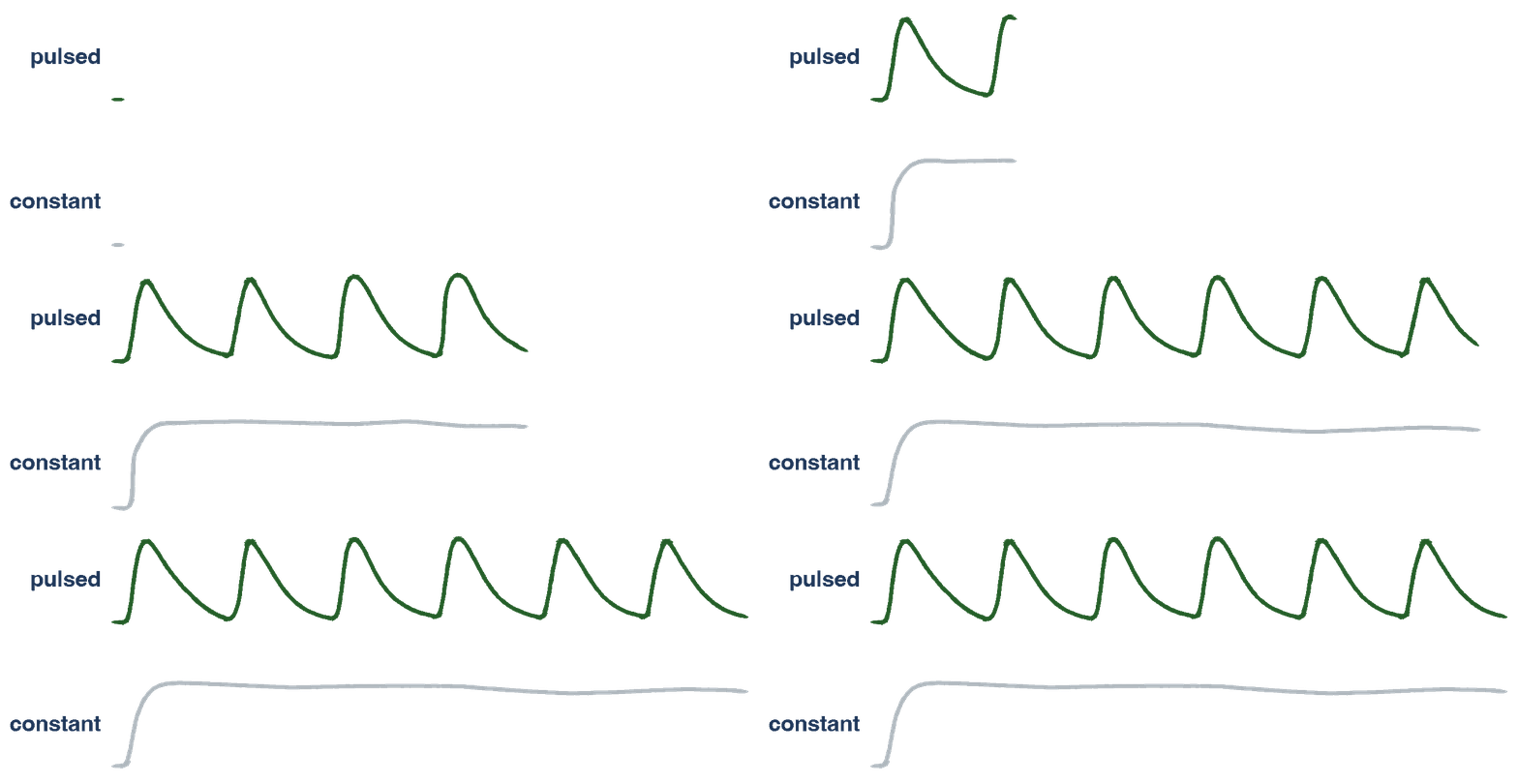
Consider the worst CPR ever: a person lines up their hands on the patient’s chest, pushes down, holds for a long unbroken stretch of stillness,
(French film title card)
fin.
This is not good CPR. If you want CPR to work, you need to pulse it—repeatedly apply chest compressions in sync with the beat of Stayin’ Alive to keep blood flowing through the body. Pushing down on someone’s chest and keeping your arms there is spatially similar to CPR but temporally dissimilar. You gotta have a rhythm for it to do anything!
The drug equivalent of the single-push CPR is a long half-life drug, i.e., the drug you only need to take once a month because it stays in your body for such a long time. So easy, and incredible for adherence! Much harder to forget than a once-daily dose. Many successful drugs are long half-life drugs.
But many drugs fail, including long half-life drugs. And one of the reasons this could happen is because the drug is like CPR: it needs to groove to work.
Caffeine is an obvious case where “ability to be pulsed” and “does it work” are intertwined. You don’t want to come into the hospital for a 30-day half-life caffeine infusion. Yes, it will keep you alert on the day you first get it. Then it will mess up your sleep for the next two months. Light, which I’ve already mentioned is a drug, is another one best served pulsed. Bright days and dark nights are the recipe for maximizing circadian health. Constant bright light is torture.
But what about drugs that aren’t one degree of separation away from sleep? Do any of them work worse when they fail to engage a target in a rhythmic way?
Well, NaR (nicotinic acid riboside), a NAD+ precursor, might be exactly this. In a recent Cell Reports paper, lead author Ivan Vlassakev and collaborators found that NaR (a close neighbor of supplements you could take to help combat aging) is naturally pulsed by the liver clock in mice over the course of the day. Pulsing doses of NaR helped young fat cells mature and store more fat (good for metabolic health), while constant dosing had the opposite effect. Just like chronic exposure to caffeine, it blunted the benefit (alertness, in the case of caffeine; adipogenesis in the case of NaR) it was supposed to bring.
You could call drugs like this “failures to jive”—they need to be rhythmic to work. NAD+ supplements are out and available for purchase (and possibly being dosed in suboptimal ways), but it’s no grand leap to wonder if there are drugs out there that could have failed altogether because they were CPR-like in function, but not dosed in a CPR-like way.
Arcascope, my company, does drug rescue and repurposing aimed at correcting mistiming failures. Critically, this doesn’t just mean “they took it at 8:00 am, and the right time was 8:00 pm.” It means personalizing dosing to the patient’s biological time, enhancing their circadian amplitude to increase effect size, and accounting for the circadian-bungling effects of drugs like dexamethasone.
And it also means reformulations which allow rhythmic dosing—dosing that would be impossible with longer half-life drugs. It might make the drug more annoying to take, but there is an upside: it will actually work.
Thanks to Paul Petrus for reviewing this draft!