


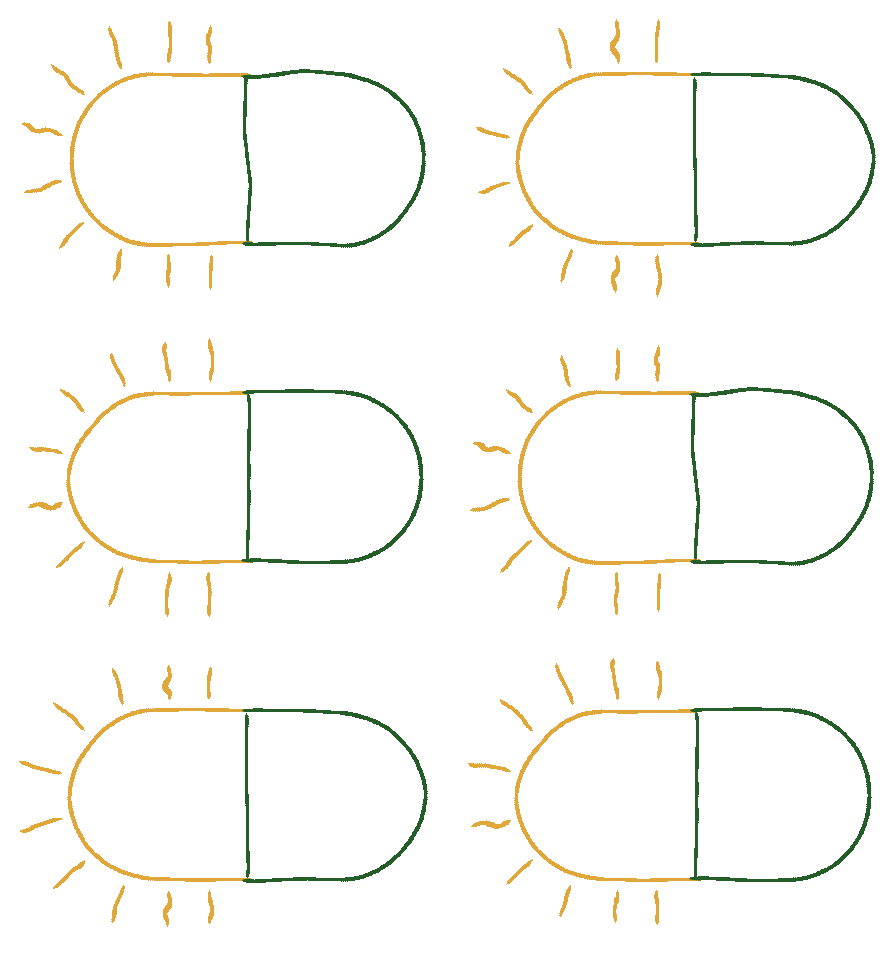
I’m out for breakfast with a friend of mine.
“My sleep is horrible,” he says. “I feel terrible during the day, then I get in bed at night and don’t feel tired.”
“Wow,” I say. “That’s so rough.”
“Yeah,” he says, pulling a bottle of melatonin pills from his pocket and twisting it open. “And I’ve tried everything.”
“Everything?” I repeat.
He pops a melatonin pill in his mouth and washes it down with a sip of orange juice. “Everything,” he replies.
It’s 9:42 in the morning. The sun is blazing in our eyes. He’s just taken a pill with five hundred times more night-hormone than the human body naturally produces on its own.
If the above was a real thing that actually happened, my next words would have been “Okay, well, maybe don’t do that, the thing you just did.” Taking melatonin in the morning is a bad idea for many reasons: it makes you groggy during the day, it makes it harder for you to fall asleep that night, it screws with your glucose tolerance. It’s also something basically everyone knows not to do: melatonin is a sleep pill, and you take it around the time you want to sleep1. Obviously.
Except people do this all the time! It’s just that instead of it being melatonin in the morning, it’s light at night.
Melatonin is negative light; light is negative melatonin.
First, accept that light is a drug. It is. When you are exposed to light, a chemical effect is triggered in your body that’s comparable to many things you take in pill form. In terms of “ability to change the time your body thinks it is,” a bright pulse of light is better than melatonin as a pill. You’re hooked up to an IV through your eyes anytime the lights are on, and sometimes it’s making you healthier and sometimes it’s making you sick.
Once you’ve accepted light as a drug, then you can start to see all the ways in which it is anti-melatonin, and melatonin is anti-light.
Light suppresses melatonin production; melatonin makes you less sensitive to light.
Light in the biological evening phase-delays you (or “late-ifies” you, makes you more of a night-owl); melatonin around then phase-advances (“early-ifies”) you.
Light in the biological morning phase-advances you; melatonin at that time phase-delays you.
Light in the middle of the biological night suppresses circadian amplitude. Melatonin at that time: well, you’ve got more melatonin! That specific rhythm, at least, is now higher amplitude.
They’re yin and yang; push and pull. When you get light at night, you’re doing the upside-down version of popping melatonin at brunch.
“Yeah, I’m not really getting that much light at night.”
Look me in the eyes and be honest. Do you turn the lights off at the same time every night.
You look away. OLIVIA reaches out and grabs your chin, turning your face back towards her.
OLIVIA
Do you… really?
A long beat. THEN:
Well, I sure don’t! And I’m a maniac about this stuff. I’ve experienced phenomenal benefits from having a very, very consistent bedtime, and I still pull “just one more email” shenanigans all the time.
Here’s the reason this matters: Light at night and light irregularity are the same thing.
If someone tells me they get bright light at 3:00 am, my first response is “probably not good.” But it’s probably instead of surely because if you get bright light at 3:00 am as part of a schedule where you, for whatever reason, stay in the light from, say, midnight to 4:00 pm every day and avoid it outside that time, I’d change my answer to “oh, never mind, you’re fine.”
Because if you do that every day, 3:00 am is no longer your biological night. That’s been shifted to start around when you turn the lights off, at 4:00 pm. You’re getting light during your body’s day, an extremely normal thing to do.
To really grind the pencil point down to a stump: Light at night is bad when it’s light during your biological night. There’s nothing intrinsic to the hour number on the wall that makes it friend or foe. Biological night is set by what you do regularly. Irregularity means, definitionally, that you are getting light at a different time than you did yesterday. Unless you live in a cave, this means you’re getting enough light that some of it is sloshing over into your body’s biological night.
A.k.a. the bad time.
So all we have to do is turn the lights on and off at the same time every day, and all problems in life will be solved
Yes.
Alright, actually no. Because people by now have generally heard the good news about sleep stability and circadian health, and they’re not turning off the lights at the same time every day regardless. I, knowing everything I know, still do not put the computer down when I have one more email to send.
When I say “light regularity is the low-hanging fruit that nobody wants,” I’m talking about this revealed preference. We gave humans the power of the light switch, and they immediately started chugging photons all hours of the day. Yes, I chug fewer photons at night than I would if circadian health weren’t my literal job, but if even my track record isn’t perfect, why should I expect anyone else’s to be?
This is the part where I reveal myself to be a Gundam villain: We need to take the choice away from people. Humans cannot be trusted with the light after dark. My mobile suit is LUME-004, and I use it to knock out the electric grid. Soon, all of us will once again experience the sweet embrace of true dark at night.

Here’s what we actually need:
Real-world-compatible light guidance: A reason people reject “turn the lights off at the same time every night” is that sometimes you can’t. Sometimes you just have to get the thing done. When that happens, your rhythms get jostled. The right lighting can help you efficiently jostle them back into place.
When I get light late at night, I compensate the next morning with extra morning light. Clairoe, my company’s circadian health app, was designed to make sleep and light plans for people who can’t always keep a fixed schedule, but want to get back on track as fast as possible when they veer off course. Real life is going to cause dynamic lighting disruptions; there are better tools than “static bedtime” at our disposal.Closed-loop lighting systems that adjust to your biology without you having to do anything. The lights in your house dim and change spectrum automatically based on what you, specifically, need for your sleep/circadian health. This helps you feel sleepy on a natural schedule, instead of tricking your brain into believing the sun is still up. Yes, of course, you can override it.
I’ve got a version of Clairoe that I’ve hooked up to smart lights in my house for this exact purpose. My dream is to ultimately build this out further and hook it up to motorized blackout curtains, too. You don’t have to give up lighting control all the way to experience the benefits of delegating. Your home could adjust your environment to take care of you.To make light’s effects as intuitive as taking a pill: I often say that circadian rhythms are like an audio recording of a sentence that’s been slowed down to 0.1x speed: you hear something, but because it’s so slow, you can’t derive any meaning from it. It’s just sound. With circadian rhythms, we know there’s something there, but we don’t map “light I got this morning” to “falling asleep faster tonight” the same way you don’t map sounds slowed beyond recognition to subject-object-verb.
A pill is grokkable in a way that hours and hours of cumulative lighting history is not. In our apps, we’ve built features that highlight how things you’ve done in the last 24 hours could affect your sleep tonight, and we’re always trying new things aimed at the same goal. If someone plays the audio recording at normal speed, you get it instantly. We can unlock that for circadian effects on health as well.More innovation: A pill that boosts your circadian amplitude and makes you more robust to light at night! A pill that dulls your light sensitivity while maintaining visual acuity at night! Special glasses! Special screens!
A little more faith: “Nobody wants to turn their lights out at the same time every night, even though it will make them healthier” is a clear overstatement. For as much as I was playing up the bit, I’m really very good about it. Lots of people are: I truly believe that when you start down the road of light and sleep regularity, you get addicted to it.
Spend two weeks getting bright days and dark nights on the same schedule every day, then try to go back to leaving on overhead bulbs after dark without hissing at them like a raccoon. Once you get a taste of the low-hanging fruit of light regularity, you start to crave it.
But until you get that taste, closed-loop systems will surely make it easier. LUME-004 as backup.
Probably many people take melatonin later than they should if they want to phase advance themselves, but that’s another story.
My school year is about to start, and I'm looking forward to getting back into my sleep routine. I look forward to turning off the lights at the same time every night and getting light in my eyes at the same time every morning. I agree that it's addicting, and people don't understand me when I try to explain this addiction to them. If I could sync my app to my house, I'd love it! My wife...not so much.