


It’s 2015, and someone at Peloton Therapeutics is making the call for how to dose their new molecule, PT2399, in its first in-mouse experiments. They choose to dose once daily. It happens, for whatever reason, to be easiest to deliver this dose late in the day. The drug ends up being indistinguishable from placebo in its ability to suppress tumor growth—unfortunate, but that’s drug development for you. HIF2α remains undruggable. The company winds down.
Wait, sorry, I’m getting reports that that’s not what happened. Rewind.
It’s 2015, and someone at Peloton Therapeutics is making the call for how to dose their new molecule, PT2399, in its first in-mouse experiments. They choose to dose once at the start of the day and once at the end of the day. The molecule works: it suppresses tumorigenesis in 56% of patient-derived xenografts and beats sunitinib in efficacy. In humans, its descendant PT2977 beats everolimus on progression-free survival and response rate in a Phase 3 trial. Merck acquires Peloton for $1.05 billion dollars, with another billion in milestones pending, and the FDA approves PT2977, now belzutifan/Welireg, for the first of several indications in August 2021. As of writing, sales have climbed each year to a cumulative $1.6 billion+ worldwide. (That’s drug development for you.)
Blink and you’ll miss it, but the difference between these two worlds is that in one case the original drug was dosed once a day, late in the day, while in the second, it was dosed both morning and evening. This matters because PT2399 doesn’t work in mice if you only give it late in the day. Look, here’s the paper if you don’t believe me:
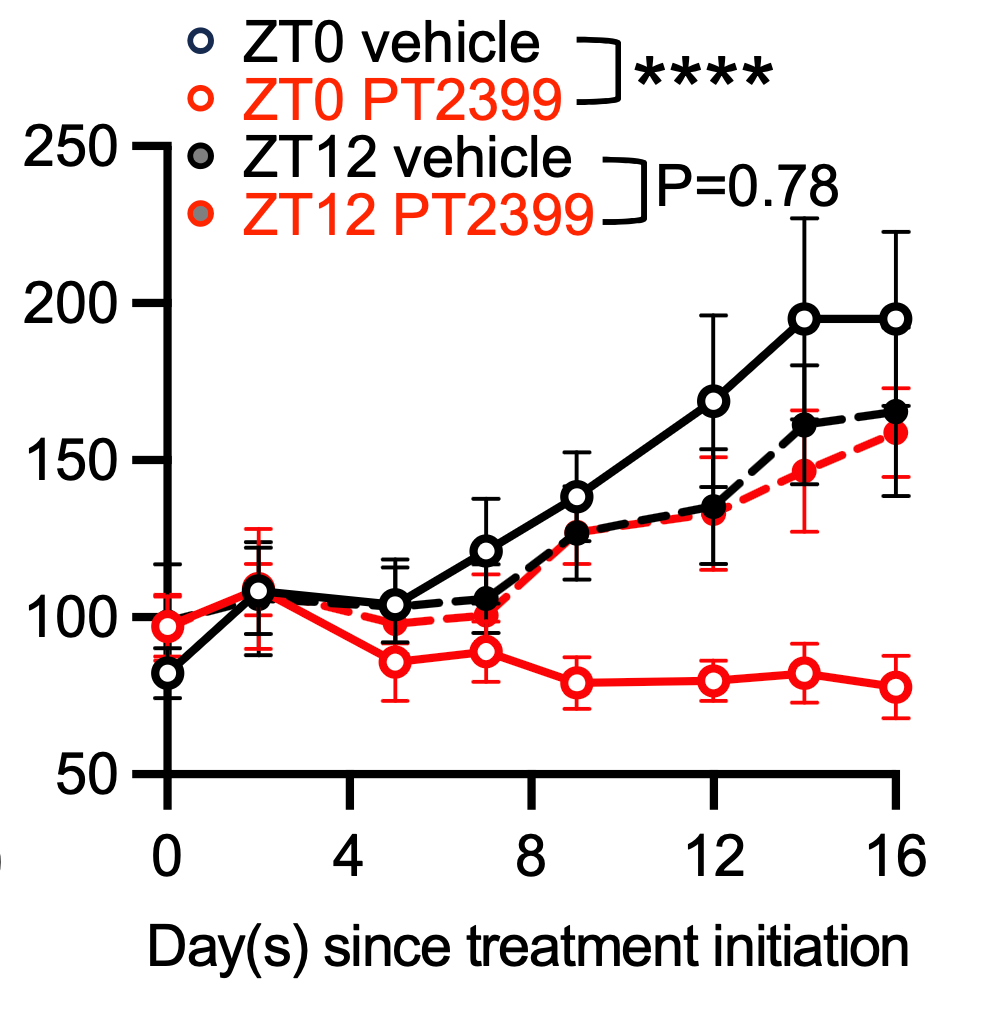
Wow, you might be saying. That’s lucky. I guess there was one time in history that a drug could have failed if they dosed at the wrong time.
It’s 2007, and Amgen is trying to decide how to dose motesanib, their short half-life VEGF inhibitor, in the MONET1 Phase 3 trial. The drug has had promising Phase 2 trial results, and poor outcomes with twice-daily dosing have pushed them to once-daily dosing. They decide that the protocol will instruct patients to take the drug once daily, first thing in the morning. The drug shows signs of activity but fails to meet its primary endpoint of improving overall survival—a narrow miss, one where a 5% change in hazard ratio would likely have been enough for a significant effect. After one more failed Phase 3, the drug is shelved.
This is the world we live in. But maybe it didn’t have to be that way. After all, motesanib is much more effective and less toxic when it’s dosed daily at night. Look, here’s the data so you can see what I mean:
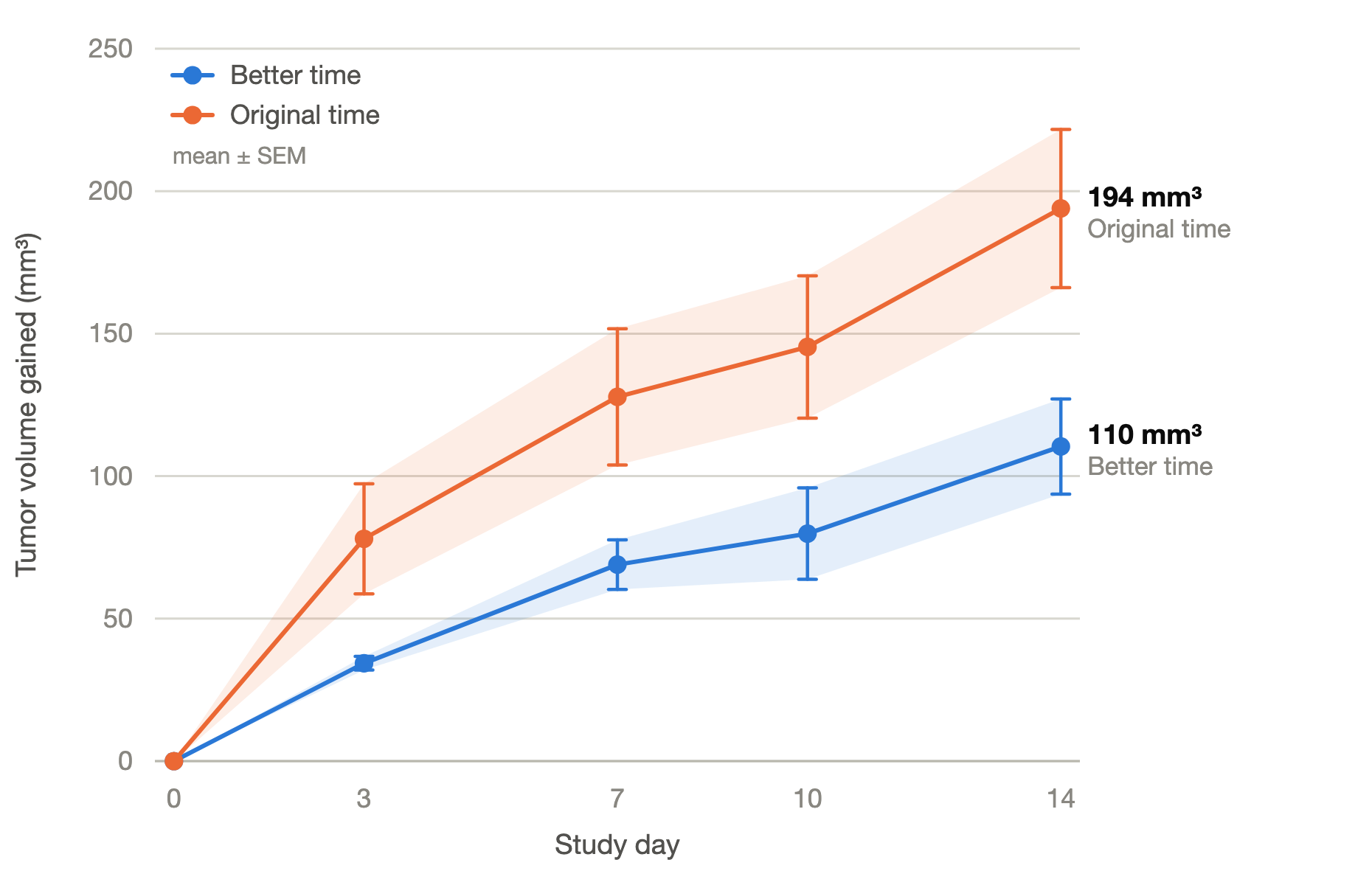
They didn’t know this when motesanib was being trialed, the same way Peloton (presumably) didn’t know about the time dependence of PT2399. The difference between the two groups is that one was unlucky in dose timing; the other was lucky. That, and two billion dollars.
Why I’m a zealot about timing in drug development.
The PT2399 result comes from the lab of Dr. Katja Lamia at Scripps Research Institute; the motesanib data comes from my company, Arcascope, where we’ve identified whole classes of drugs that we think failed because timing wasn’t considered. Briefly, the logic goes like this:
1. The body is not constant in time. It’s rhythmic all the way down.
2. Therapeutic windows aren’t constant either.
We act like they’re this:
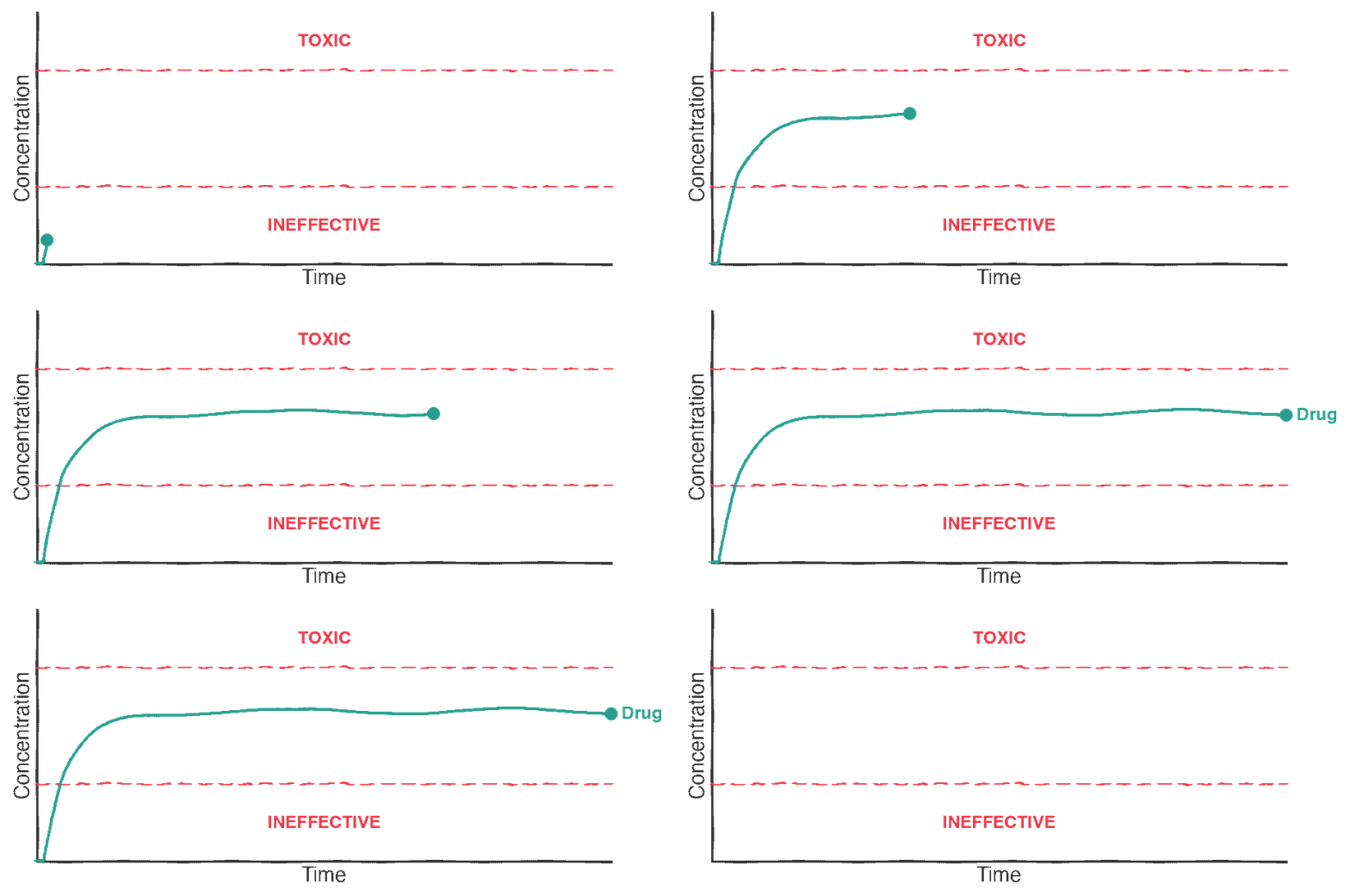
When really, they’re this:
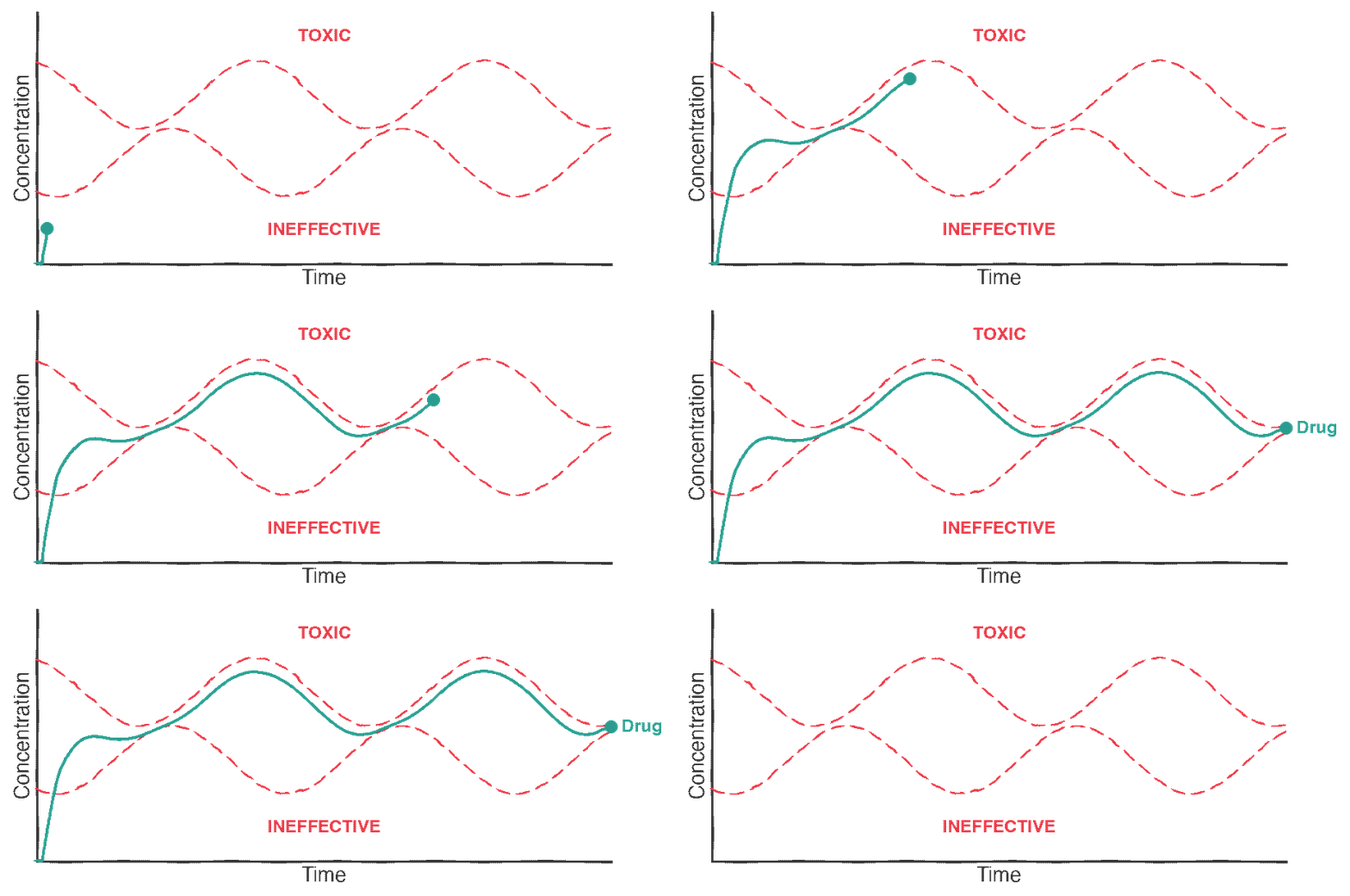
3. Many approved drugs could probably be time-optimized to be more effective or less toxic. See: belzutifan.
4. Many failed drugs could also probably be time-optimized to be more effective or less toxic. Like motesanib. Like the others we’ve found.
5. This is the opportunity. We can rescue drugs by delivering them differently in the fourth dimension. Time is a whole additional dimension to explore and exploit. Let’s explore and exploit it.
Why Hasn’t This Been Done Already?
“People can’t measure circadian phase in the real world.”
Ah, but we can. We’ve been collecting data for years to build best-in-class methods for tracking circadian rhythms in real world conditions from devices you already own. Not generic, not static in time: we can figure out the best time for this specific drug, on this specific day, for you.
“People don’t know what drugs have timing effects, how many are out there, and what the best time is.”
We can figure it out with mechanistic models. Arcascope’s drug discovery platform, chronoRCT™, takes circadian expression datasets and builds mathematical models of the underlying systems, allowing us to probe optimal timing in silico and confirm it at the bench, like we’ve done with motesanib (and more!).
How many drugs like this are out there? We think many. After all, timing effects are extremely easy to miss.
For starters, we systematically dose nocturnal rodents during their rest period (the light) while dosing humans during the active period (also the light). There are many, many reasons why drugs can work in mice and fail in humans, but one of them surely is this consistent bias wherein dosing in mice vs. humans is literally night and day.
After all, do you know anybody testing delivering a drug every four hours for 24 hours that isn’t a circadian biologist? It’s an incredibly annoying experiment to run because it means everything is six times more expensive and someone is losing sleep. If I tried to sell you “Make Everything Six Times More Expensive (And Someone Is Losing Sleep)” as a product, would you sign off on it? Would your boss?
And let’s say you get promising enough results to go into human trials. The natural spread of human circadian rhythms is wide across the population and moves within an individual from day-to-day. Without circadian-tracking technology like ours, you’re shooting in the dark. You could get lucky in a Phase 2 trial through a happy collision of protocol-specified timing and biological timing of your participants making it so the overlap between drug and target is good enough for an effect. The odds of this luck continuing in a Phase 3 dwindle as N scales.
The biggest proof that people are missing this is that they missed it. Belzutifan’s been out for five years now; Dr. Lamia’s lab only published their findings a year ago. All once-daily short half-life VEGF inhibitors tried in the US failed. In the post-mortems dissecting what went wrong, nobody considered that the timing was just wrong.
What a time-based drug rescue looks like
Here are three potential shapes:
A drug works, but only when it’s temporally aligned with its target. The only way to make it work is to time it right.
A drug works but has significant toxicities from off-target effects. The only way to make it work is to time it right. (This is the last one wearing a different hat.)
A drug interacts with a rhythmic process. If it flattens the rhythm out, there are negative downstream consequences that outweigh the benefits of the drug. The only way to make it work—to keep the rhythm it interacts with healthy—is to pulse it.
I’ve got examples of all three of these that I’d like to try to rescue. And for that, I need some help.
Call me if this is you
I’m a computational biologist by training. I need someone with clinical development experience to join my team.
I’m looking for other people, too: industry advisors who can guide me on the path of the first in-humans timing rescue, drug developers who hear echoes of an asset they worked on in what I’m saying, and skeptics to argue with me so I don’t go down bad roads.
But a clinical development person is who we need most. We want you if you’re frustrated by the 90% failure rate of drugs in clinical trials, if you’ve been on the inside of bringing drugs to market and think there’s a better way, and if what I’m saying about “drugs can resonate with their targets” resonates with you.
What you’ll do:
Help us pick which drug we should move forward first. We need to balance the likelihood of success with market size and path to patients. We’ve got ideas, but we want yours.
Help us design our trial. Build the protocol that makes the best possible case for our drug, up against the closest competitors in standard of care. We want our drugs to be clear winners, not also-rans.
Chart the regulatory path. Timing rescue is a new idea. It’ll be new to the FDA, too. We’ll need you to help us all navigate it together.
Bring in assets. Reach the companies and academics sitting on drugs that didn’t succeed and make the case that theirs could, with different timing.
Be our guide. We know a lot, but there’s plenty we don’t know yet. You’ve got the on-the-ground expertise with drug development; help us learn from your example.
Time is a whole extra dimension. Like going from still frames to movies, or static maps to GPS, when we let medicine move in time, there’s incredible value to be had. Somebody is going to hit play and start chronomedicine rolling. I’d like it to be us. Sound interesting? Reach out.
With thanks to Katja Lamia for her feedback and Franco Tavella for coming up with the therapeutic window plots.
Love the examples and perspective by Olivia here! The difference between a medication successfully treating someone might depend on when they take it. Seems obvious, but as she highlights there is clearly a TON of work still to do!