


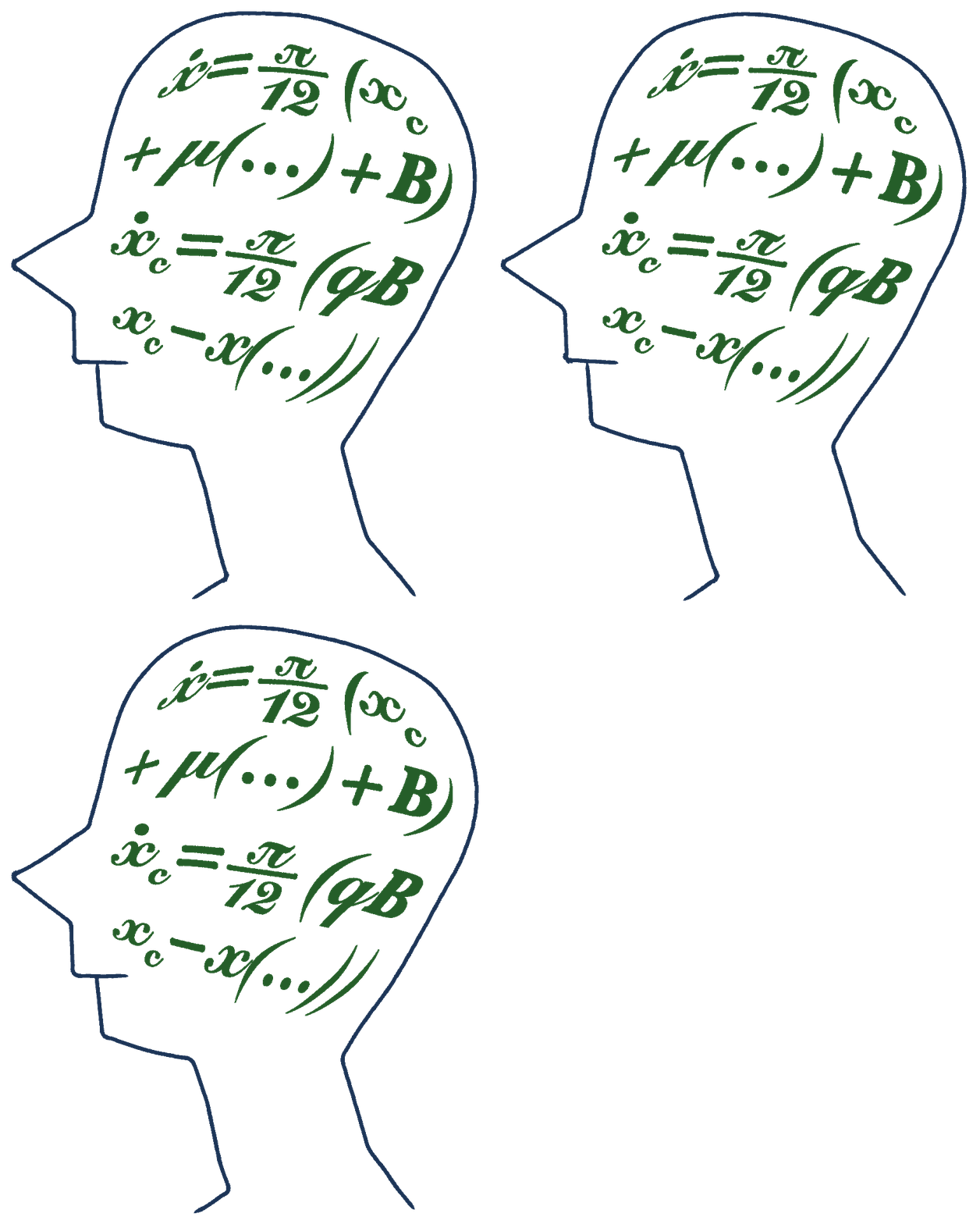
I’ve got a really good computer. You give me someone’s genetic code, and I build up a virtual copy of their whole body—cells, tissues, organs, yadda, yadda. You tell me what they eat on a given day, and I run it through their virtual digestive system. You tell me how much they move, and I apply wear and tear to their virtual muscles. Maybe I get a reading of something real (heart rate, blood pressure, percent body fat, whatever) off the person, to better tune the system to them. Maybe I just let it rip.
Now you come to me and ask: “What’s the likelihood this person dies of atherosclerosis?” My answer won’t be, “well, a person of their age and general demographics has X% risk of…” No!
I’m going to pop open my virtual copy’s arteries and see how bad they look. I’m going to take my virtual person and repeatedly stress them out first thing in the virtual morning, and count how many times they have a virtual fatal heart attack. I’m going to give my answer1 in a way that’s informed by the mechanisms of everything I know about how their body works and everything they’ve done to it as they, specifically, have lived their life.
This is what all the risk factor scores are trying to get at. Humans have been forced to use crude proxies for health like calories eaten in a day, hours slept, miles jogged when what we really care about is “is my body going to keep working or not?” And the way to answer that question is with a virtual body.
This is on my mind because I recently gave a talk at the Taiwan Society of Sleep Medicine’s annual meeting, where I covered, among other things, the various scores used to capture a person’s sleep regularity and rhythmicity. There are a bunch: intradaily variability, interdaily stability, 24-hour autocorrelation, relative amplitude, sleep regularity index, you name it.
They each pick up on something slightly different, and they each come with their own quirks and foibles. They’re generally designed to reward you for having a really regular schedule. A lot of them inadvertently reward you for being inactive all the time and/or doing the same unhealthy pattern every day (“barely move/see light at all, but do the same thing every day” can get all of them; “sleep for an hour, be awake for an hour, repeat forever” gets many). But they’ve been very useful at moving the field forward on regularity as a metric to care about.
Of all of them, I love the sleep regularity index (SRI) the most. The sleep regularity index asks: “what’s the probability that 24 hours from now, you’ll be in the same sleep/wake state (asleep or awake) as you are right now?” It’ll be high if you’re very consistent; low if you’re not.
I think the SRI had a huge impact on how we think about sleep health in the field, and I think a lot of people are going to live better lives because of it. But I also recently saw a paper that said (paraphrasing here): “Sure, but isn’t it complicated? How are patients and clinicians supposed to work with a metric so complex?”
“My brother in Christ,” thought I, sweating. Because the metric I like most of all for understanding regularity is a digital twin. I want to take your light exposure, your sleep/wake history, and anything else I know about you—how sensitive are you to light? Does your internal clock run fast or slow?—and run it through a virtual body, then look at the virtual body’s suprachiasmatic nucleus (SCN) and ask: “Are these neurons synchronized? Does their rhythm look robust? Are they firing in a way that’s compatible with when this person needs to work, be active, and move?”
As a method, this is approximately twelve billion times less interpretable than the sleep regularity index’s friendly single number. But pass it the same unhealthy pattern repeated every day, and the digital twin won’t be tricked into thinking it should hand out a good score. It’ll add up the cost of every bad decision, every injury you sustain from a photon when your body expects dark, and spit out a number that is what you literally, actually care about. How much less melatonin you’re producing. How much less glymphatic clearance is occurring as you rest. How much more glucose is in your blood. Is your body going to keep working on not.
Clairoe is a sleep/circadian digital twin my team has built to start us down this road. It simulates a virtual SCN based on the inputs you’re exposed to in day-to-day life, and updates its estimates on when you’ll produce melatonin and when you’ll be able to sleep in real time. We’re working every day to build it out with new functionality. Getting to a digital twin at the level of the one I started this blog with will take more everything to happen: data, compute, experiments, validation. It’ll take work to map the biological quantities of the twin to things that are understandable enough to get the person being modeled to buy into them.
And it’s going to take a really, really good computer. Somehow I don’t think that’s going to be a problem.
“Not looking good, chief.”
I've been using Clairoe for a week now & its very accurate in predicting when I'm going to have my melatonin rhythms disrupted or shifted. There's definitely some individualization required since I have DSPD so I'll have to test it out for a while longer, but that's just part of the process in personalized medicine.
Obviously you don't think the bottleneck will come from computational power or the accuracy of the mathematical models you use, but is it possible that wearable tech becomes the bottleneck? It seems that there are inherent limitations in Oura rings/ Apple Watches & sleep tracking right now
so cool. we all need your digital twin tech. personalized medicine has been holy grail and we are so far away from that possibility!