


No, we shouldn’t make DST Permanent (November 2, 2021)
I recently got some blackout curtains for my bedroom. This was pretty long overdue: about thirty feet from my bedroom window is a cheerfully bright, energy-efficient street lamp, which—while great when I’m taking the dog out for a nighttime stroll—is the photic equivalent of somebody standing in my azaleas and playing “Seventy-Six Trombones” while I’m trying to sleep.
I’ve definitely started sleeping longer since I’ve gotten them. But I’ve also noticed that they’ve made it so I need to be even more careful about my other sources of light at night. The reason? They don’t just block my light at night. They also block light in the morning.
I’m thinking about this because it’s almost the end of daylight saving time, and, once again, there’s talk of making it permanent. As a quick guide: Daylight Saving Time (DST) is the one where the clocks move forward (so it’s lighter at night), while standard time is the one where the clock moves back (darker at night). The “Sunshine Protection Act”, introduced by Florida senator Marco Rubio, encourages states to observe a permanent version of DST, with the argument being that lots of good things could come out of just chilling it with the time change.
Permanent daylight saving time means not having to change the clocks, and not having to experience that gnarly “lose an hour” in the Spring. It means no confusion about how many hours offset we are from the time in the U.K. and no struggling to remember if you should say EDT or EST when you’re trying to coordinate a Zoom meeting across time zones. As a programmer, I’m generally in favor of anything that makes the totally miserable experience of interacting with dates and times in code even marginally easier.
But it also means—and I’m talking about permanent daylight saving time here—lots and lots of dark in the mornings.
This is bad. It’s bad because light at night is fundamentally different from light in the mornings, because our bodies are fundamentally different at night than they are in the mornings.
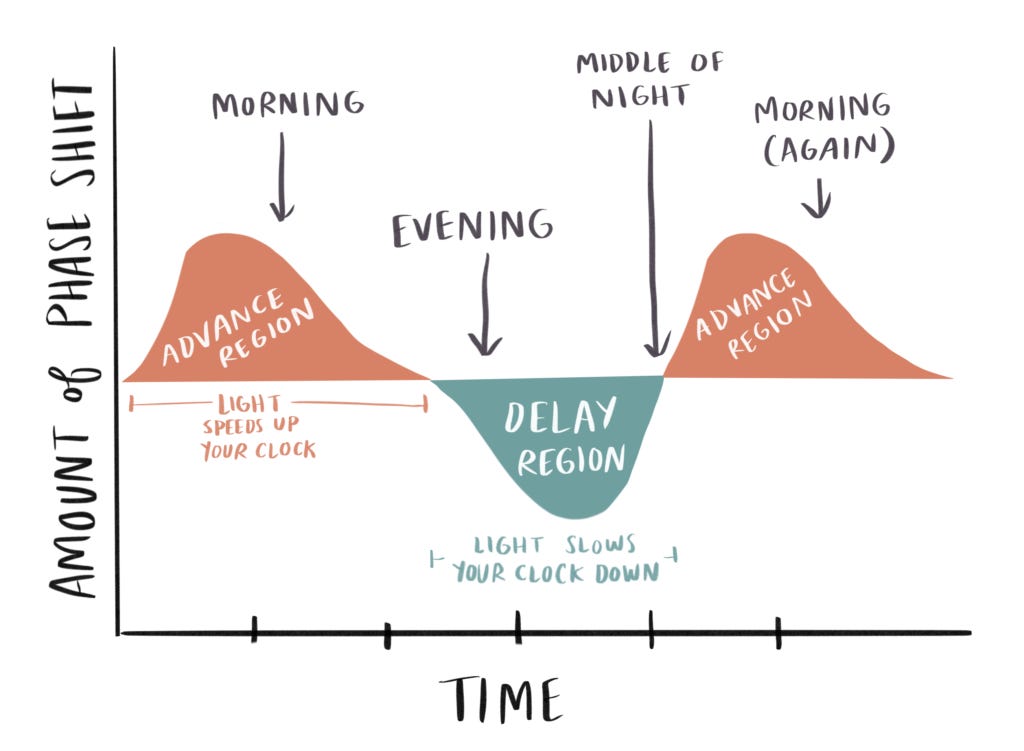
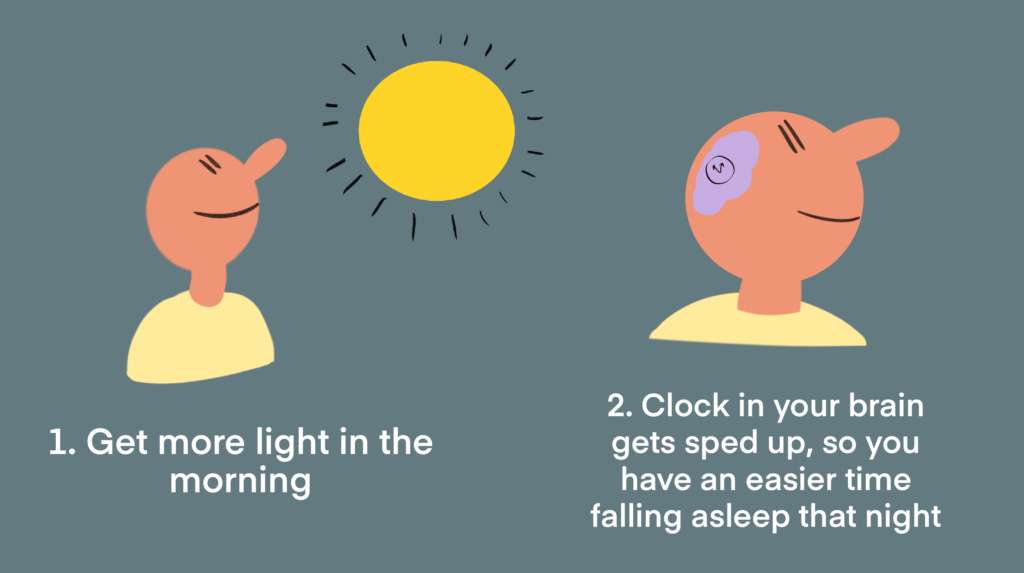
Light in the morning does a couple things, but one of the most important ones is that it “advances” our circadian rhythms. It tells our internal clock that night is over and it’s time to get a move on. It makes it easier to fall asleep at night.
And if you get a lot of light in the morning, it eventually advances you to the point where… it stops advancing you. You enter the part of your daily rhythm where light delays your clock. A sort-of “slow down, what’s the rush” period of your internal rhythm that starts in the mid-afternoon for most people and continues into the early morning.
And that slowdown period is the problem. Because while light in the morning is hitting you in the advance region, which you eventually get advanced out of, light at night is hitting you in the delay region, which is like a temporal sand trap. When you get light exposure in the delay region, your clock gets slowed down, which means you spend more time in the delay region. Which means you don’t feel tired as quickly, which means you get more light, which means you spend even more time in the delay region. It’s a feedback loop that spins out of control. It might be the reason that night owls exist.
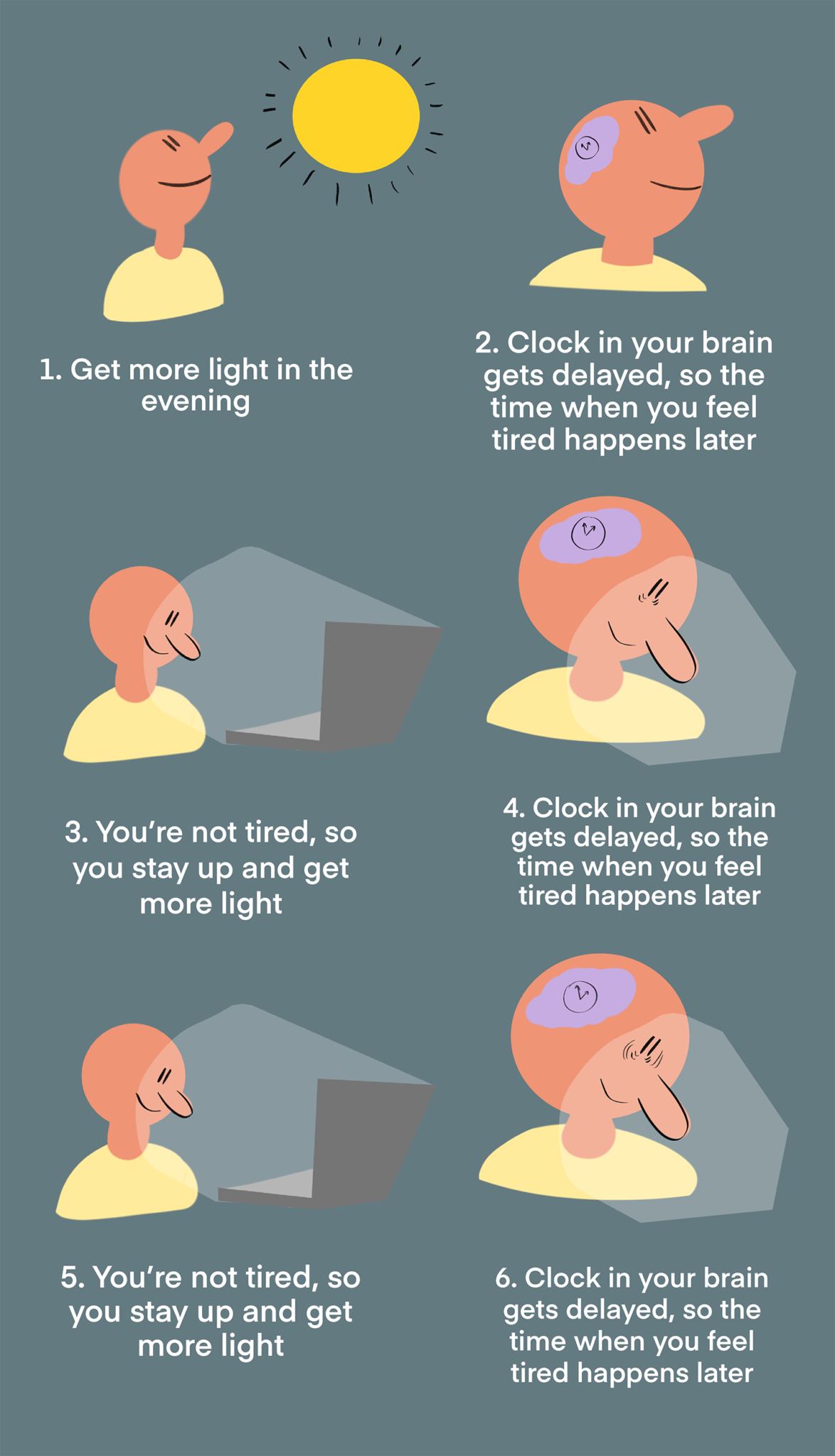
So if we adopt permanent DST, we’re adopting a schedule where we get more light during the hours most people call night, and much less light in the hours we consider morning. We’re setting ourselves up to fall into the delay region sand trap: More light in the night, making us stay up later and get delayed, and far less light in the AM hours to counteract it.
This is what tanked permanent DST the first time we tried it. I’m not sure why this doesn’t always get brought up as the very first point against permanent DST, but we’ve totally done it before. In 1973, anywhere from 57-73% of people supported staying on DST during the winter. So they did it, in January of 1974. By the time February and March rolled around, only 19-30% of people still thought it was a good idea, while 43% said it was actively bad.
What changed? People experienced what happens to your body when you have to kick off your day in the dark of night. They drove to work and caught the bus to school, while the sun waited to rise until 8:00 am. They didn’t like it, and rolled the decision back before the next winter came around.
You might say, “well, time is a fake idea. Who says you have to start your day before 8:00 am?” This is a fair point. We could, societally, shift the normal times we do things to match whatever schedule we wanted. In China, where the entire country is on the same time zone, places like Kashgar (in the far west) have shifted their normal operating hours to reflect the fact that the sun might not come up until 10 am.
But it’s a lot tougher to change social standards of when school and work “should” start in every town in the country than it is to pass a bill changing the time that appears on your phone. Which is why we shouldn’t do it: Permanent DST will put us on schedule where our traditional social standards for when things should happen are at odds with our biology, sabotaging our sleep and circadian health.
If we want to stop the whiplash of changing the clocks twice a year, why not do permanent standard time? I’m in favor of this. It reduces confusion the same way permanent DST does, but without the corresponding damage to our internal rhythms. Sure, it means that the sun will come up very early in the summer; I own this. It also means that we’ll still have those dark early afternoons in winter. But darkness at the right times is a healthy thing. And from a safety perspective, there are lots of street lamps and other sources of light at night these days that are very good at their jobs.
Which brings it back to me and my blinds: I’ve needed to be more careful about my other sources of light at night lately because my blackout curtains mean I don’t get woken up by the sun. That’s not a big problem: I can wake up in the dark and yank them open myself, like one of the townsfolk in the first song in Beauty and the Beast.
But if I get too much light at night from non-streetlamp sources, like watching Succession on my computer or looking at Succession memes until late in the evening, my ability to wake up in the dark in the morning is going to be less reliable, jeopardizing my exposure to morning light. And I’m lucky that there’s even morning light to get: with permanent DST, I could be hopping on my first calls of the day while the sky is still black outside.
My point is that social pressures already make it hard for us to get the darkness we need at night (let’s face it, the internet is fun) and the light we need in the morning. We shouldn’t make it harder for ourselves with a change to a system that’s already failed once. Permanent daylight saving time is a no-go. Permanent standard time? Call me.
My 2026 Review: This was my first post on DST (it also appears in modified form in my book, SLEEP GROOVE), and it correctly flags asymmetry of light as the fundamental problem of permanent DST. If I were to write it again now, I’d probably spend less time on the positive feedback loop of light at night (where it delays you, which makes you more delayed, which makes you stay up, which delays you more, etc.)—not because that’s not true, but because it’s 1) more relevant to summer DST, the system we already live under, and 2) telling people “light can be BAD for you” is not super compelling when the #1 complaint about all things DST is “it’s dark after work.” Live and learn.
Yet another blog about permanent Daylight Saving Time (December 5, 2024)
Let’s start with a couple obvious things. If you lived in a bunker, and you never ever saw the sun, the choice between permanent Daylight Saving Time and permanent Standard Time would really not matter to you. We could just pick one and roll with it, and you would continue to be a person who lives in a bunker and sets their lighting to whatever they want, whenever they want it.
Choosing between permanent DST (pDST) and permanent Standard Time (ST), then, is choosing where you want the sun to be, relative to all the things on your calendar you have to be awake for. The sun matters because it’s way brighter than all the lights you’ve got in your house, and it’s free, and it lights all of the outdoors. Permanent DST means you’ve got more sun later, like during the hours you’ve got free after work. Permanent ST means you’ve got more sun earlier, like when you’re driving into work. There’s been a lot of talk lately about stopping the twice-yearly time change and selecting one of these as our year-round system.
If we’re picking between these two, we’ve got to go with permanent Standard Time.
Look, I know it sucks to have it be dark outside after work. I know having a little more light when you commute home feels better than doing it in the dark.
But short days are a consequence of winter, not Standard Time. Getting more light in the evening means giving it up in the morning, and losing light in the morning is worse than losing it in the evening.
Imagine you get up for work at 7:00 am local time every day, without fail, and you turn off all your lights at exactly 11:00 pm (or 23:00) every day, without fail. You’re at your job from 9 to 5, and your only chances to see the sun are between 7:00 am and 9:00 am, and after work. We can use mathematical models of circadian rhythms to predict what your melatonin profile—your body’s biological signal for night—would look like on both ST and pDST.
Since sunrise and sunset depend on location, we can first ask: What’s the melatonin profile of a person in Miami look like in the middle of the winter on ST and pDST? Here’s what we get when we do this:
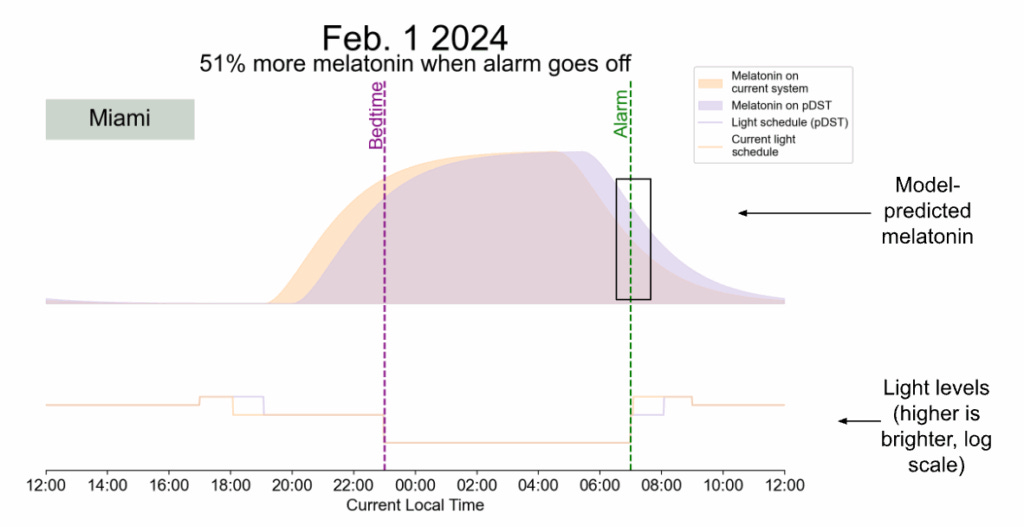
The model predicts they’ll have a lot more melatonin in their body when their alarm goes off if they’re on pDST than they would have on ST (I’ve put a box around this part to highlight it). Having more melatonin when your alarm goes off should make it harder to get up and make you feel groggier. After all, you’re trying to start your day during your body’s biological night.
The difference between the two schedules in this simulation is coming from the fact that, for people on pDST, light exposure is much lower in the morning and much greater in the evening, which late-ifies them (or “phase delays” them; makes them more of a night owl). This happens even though they’re turning off their lights at 11:00 pm each night: that late-in-the-day light is still shoving their rhythms later.
It’s not going to be the same in every location. Someone in Boston on the same day would be waking up with even more melatonin in their body when their alarm goes off under pDST than they would be on ST:
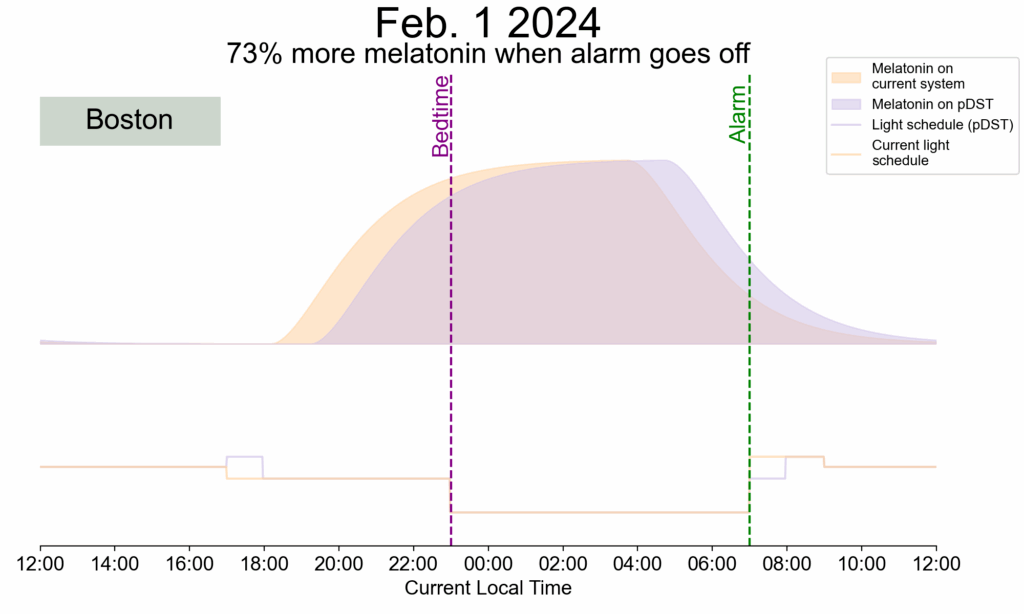
And this is with lights-off fixed at the same time every night! In reality, later light would be expected to shift people’s bedtime later, both by simply delaying them, but also through the positive feedback loop that light in the evening has, where you don’t feel tired, so you keep the lights on, so you late-ify yourself more, so you don’t feel tired, and so on. This asymmetry in how the timing of light changes biology and behavior is important not only for when we just talk about winter, but summer as well. If we go with permanent Standard Time, will the sun rise super early at some times of the year? Yep, I fully own this. But early-in-the-day light doesn’t trigger a behavioral feedback loop the way late-in-the-day light does. And even if you’re totally unconvinced by my beautiful simulations and elegant mathematical arguments, let us not forget that we did pDST in the 70s and didn’t even last a year.
The code for these simulations is on this GitHub repo, and the exact numbers will depend on your assumptions, including when you normally wake up, go to bed, and the light you get at work and at home. The results will be different for a person who never gets up until 10 am or for people who have plenty of opportunity to see the sun during their work day. Plus, mathematical models are always, at best, approximations of what’s going on in a complicated, messy human body.
The point I’m trying to make, though, is all about the trends: later sunlight drags your body’s clock later, making it so you’re trying to start the next day when your body’s still in night mode. And the pain will be felt differently in different places at different times of the year.
So on top of making it so we don’t have to worry about time changes twice a year, permanent Standard Time is the option that best aligns our body’s clocks and the social clocks we’ve hardcoded into society. Things like school start times, work times: these are the social tugs that would make a lot of us wake up in the dark (before our bodies are ready) if we adopted pDST.
And sure, we could shift the times of all human activities—school, work, lunch, anything on the calendar—to be later. But if we make sunrise later and everything else later too, we’d end up basically where we started. Permanent standard time, please.
My 2026 Review: This one is fire. It’s the first time I introduced the idea of permanent DST being bad because it causes more overlap between biological night and work, it addresses head-on the fact that people who have no work or social obligations don’t have a real horse in this race (the bunker hypothetical), and it comes with a GitHub and open source code! Truly revolutionary stuff here; I was cooking.
Maximizing light is not the goal for health (December 19, 2024)
Imagine it’s summer and you live way up north. The sun is up for 22 hours of the day. Sunlight is good for sleep, right? Your sleep must be great.
Except, no. It sucks. And the reason it sucks isn’t just because it’s hard to sleep when it’s bright outside (people in northern latitudes know about blackout curtains). It sucks because sleep is a rhythm, and sleep suffers when your light exposure isn’t rhythmic enough.
Said another way: There are times of the day when you want light—a bunch of it!—for good sleep. But there are also times when light is actively bad for sleep.
This isn’t an easy concept to get. People are hardwired to understand “more of good thing” → “better” and “more of bad thing” → “worse.” We’re less adept at reasoning about things where the way you get more of the good thing is by being more rhythmic.
My eternal analogy is that sleep is like being on a swing.

Light exposure is like a push in the outward (forward) direction.
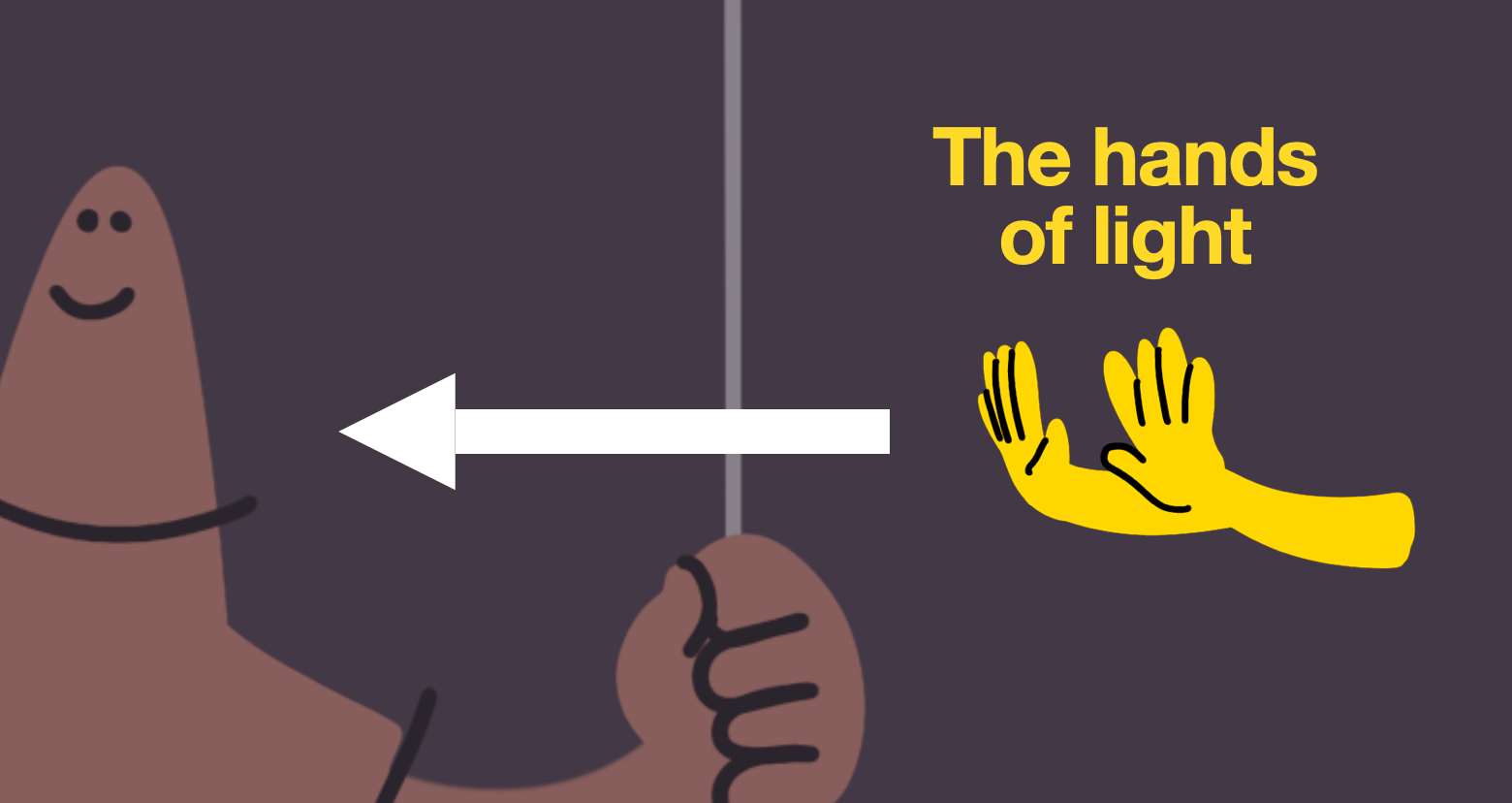
It’s good to get pushed forward when you’re heading forward.
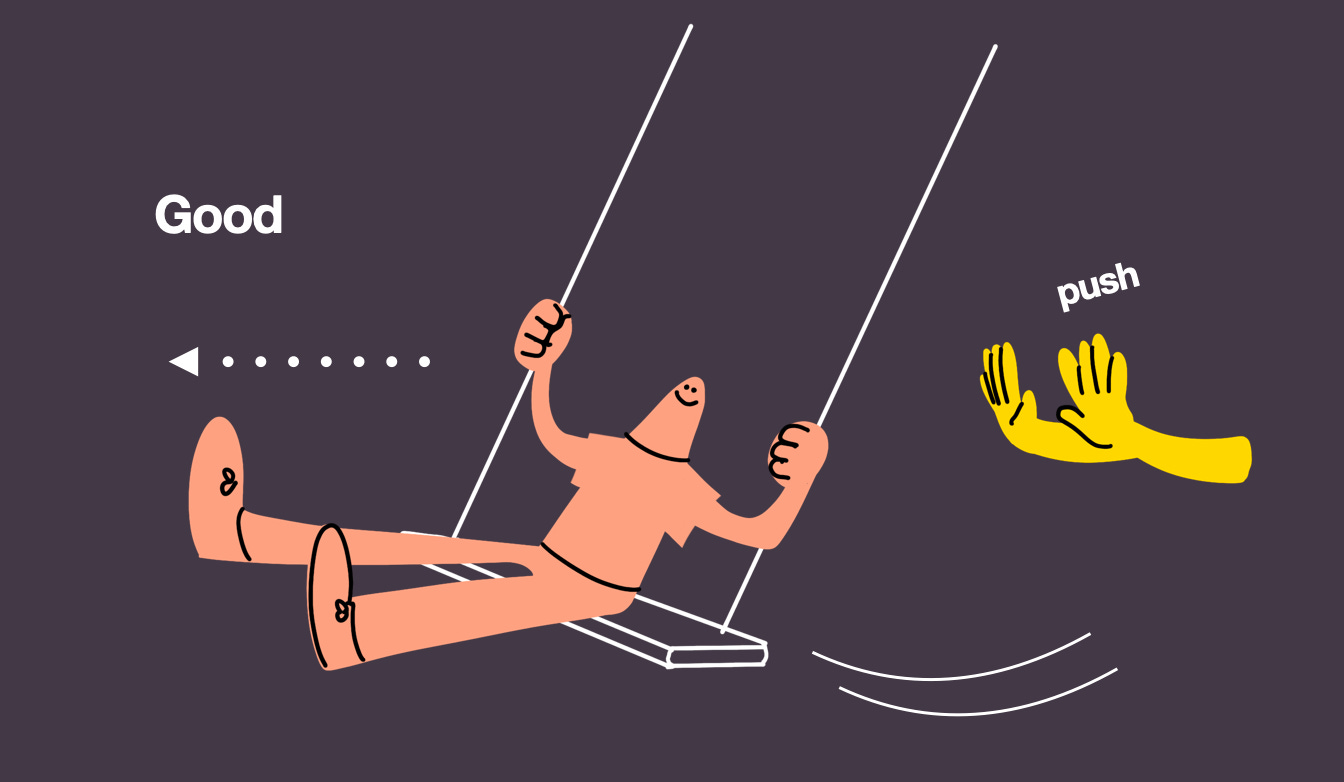
It’s bad to get pushed forward when you’re heading backwards.
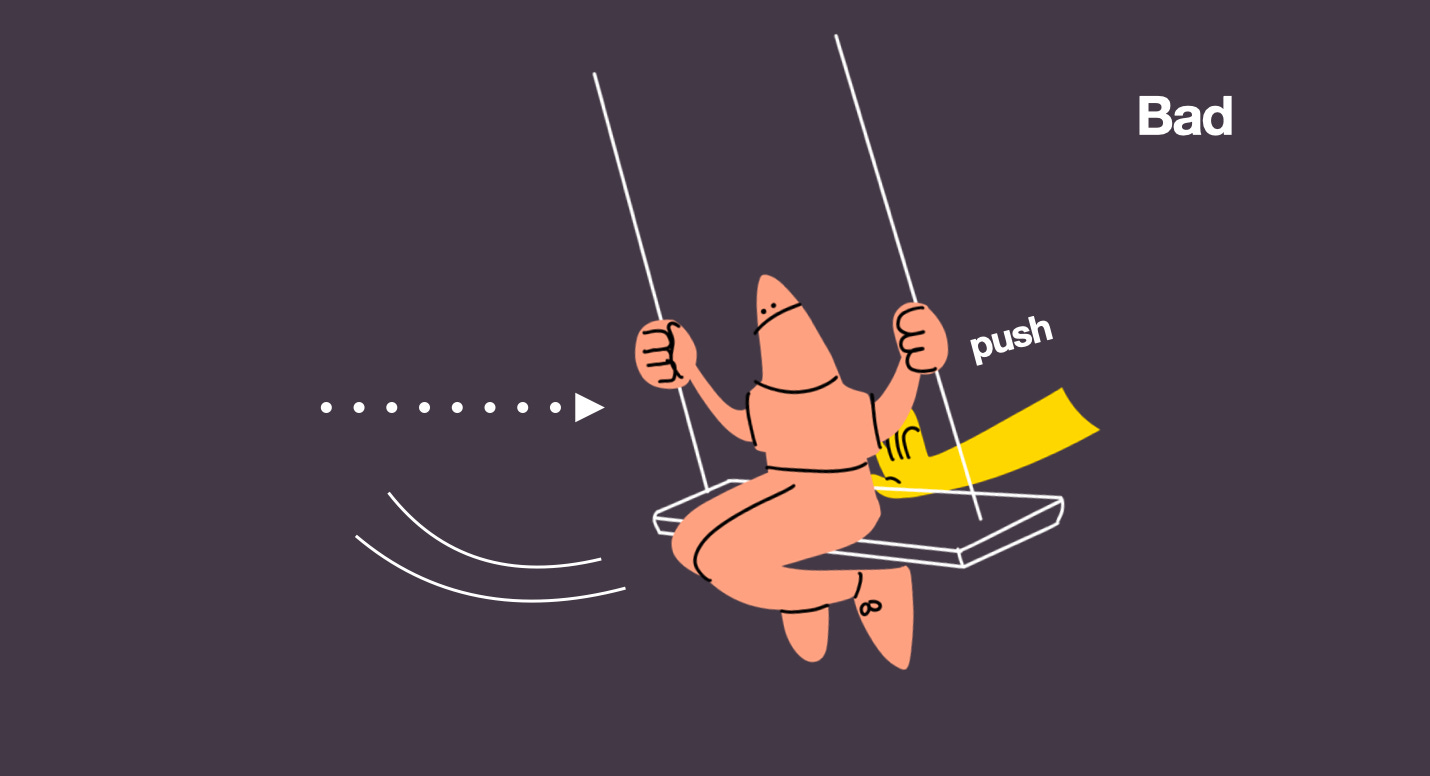
Light’s the same way. If you had 22 hours of daylight available to you, there would be times where that light was good for your sleep, and times where it was actively screwing your sleep up.
“Hang on,” you say. “I see where this is heading. You’re going to tell me that late daylight in the summer on Daylight Saving Time (DST) is screwing my sleep up, and that’s why we should switch to permanent Standard Time (ST). Except that’s stupid, because we’ve had DST in the summer for decades, and everything has been totally fine.”
You got me. Would sleep be better on Standard Time in the summer? Yep. Have late sunsets and DST in the summer caused the world to end? Of course not. This is one of the reasons why many sleep/circadian people have their order of preference for time systems as:
(best) Permanent Standard Time.
Current system where we do Standard Time in the winter and DST in the summer
(way, way down) Permanent Daylight Saving Time.
We’ve gotten by on summer DST for a long, long time. And people live at these super northern latitudes! They’re not collapsing the second they get a 22.1 hour day and gasping out, “it… was the light… that did it…. (eyes turn to cartoon Xs)” in their final moments.
But adopting DST in the winter is a really bad idea. There are good safety arguments to be made, but as a circadian mathematician, I think of it this way: on permanent DST in the winter, you have very weak light at the times you’d want it, given when society is making you have to get up…
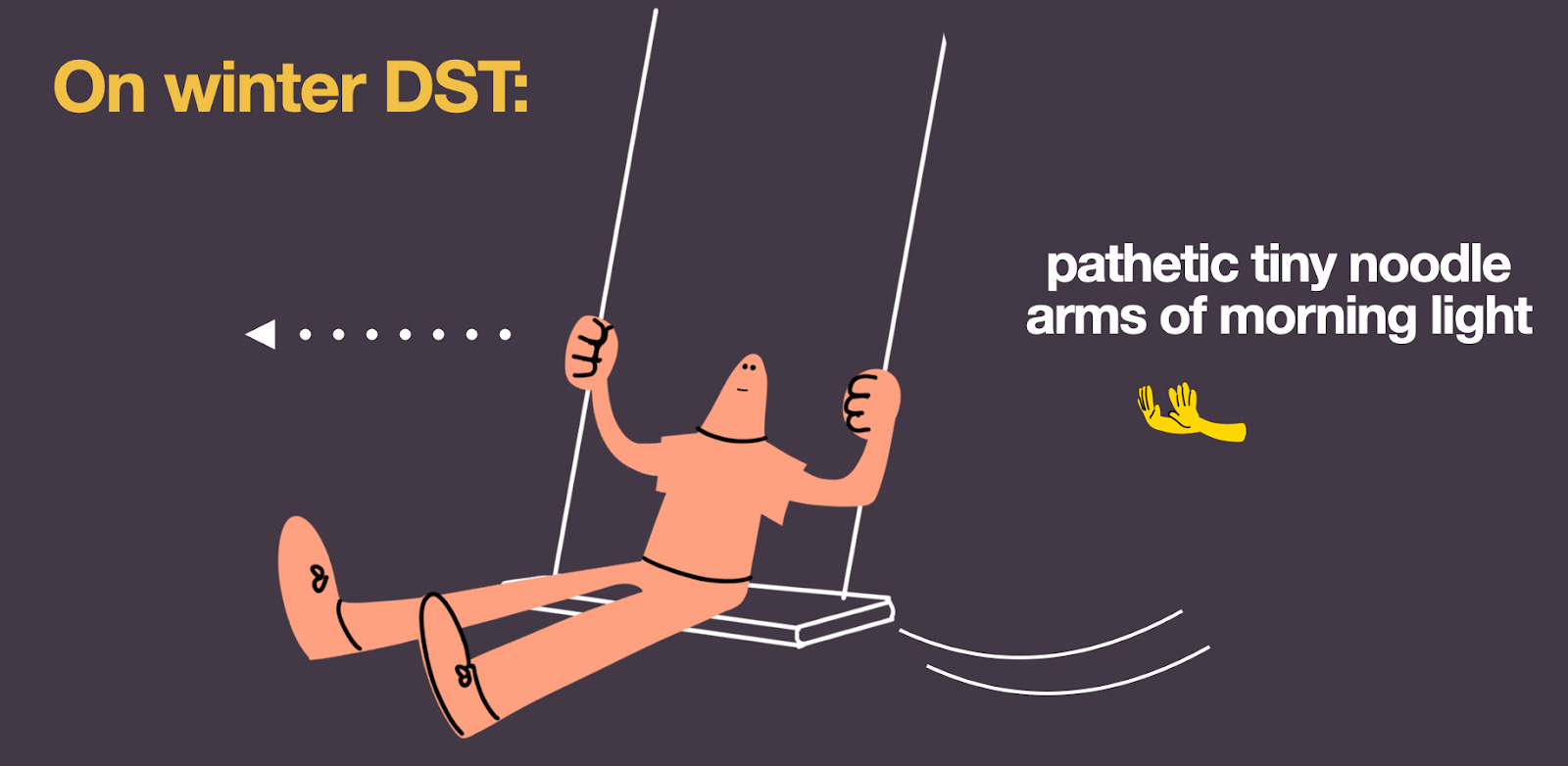
…and too much light later in the day, when light’s having the opposite effect on your body.
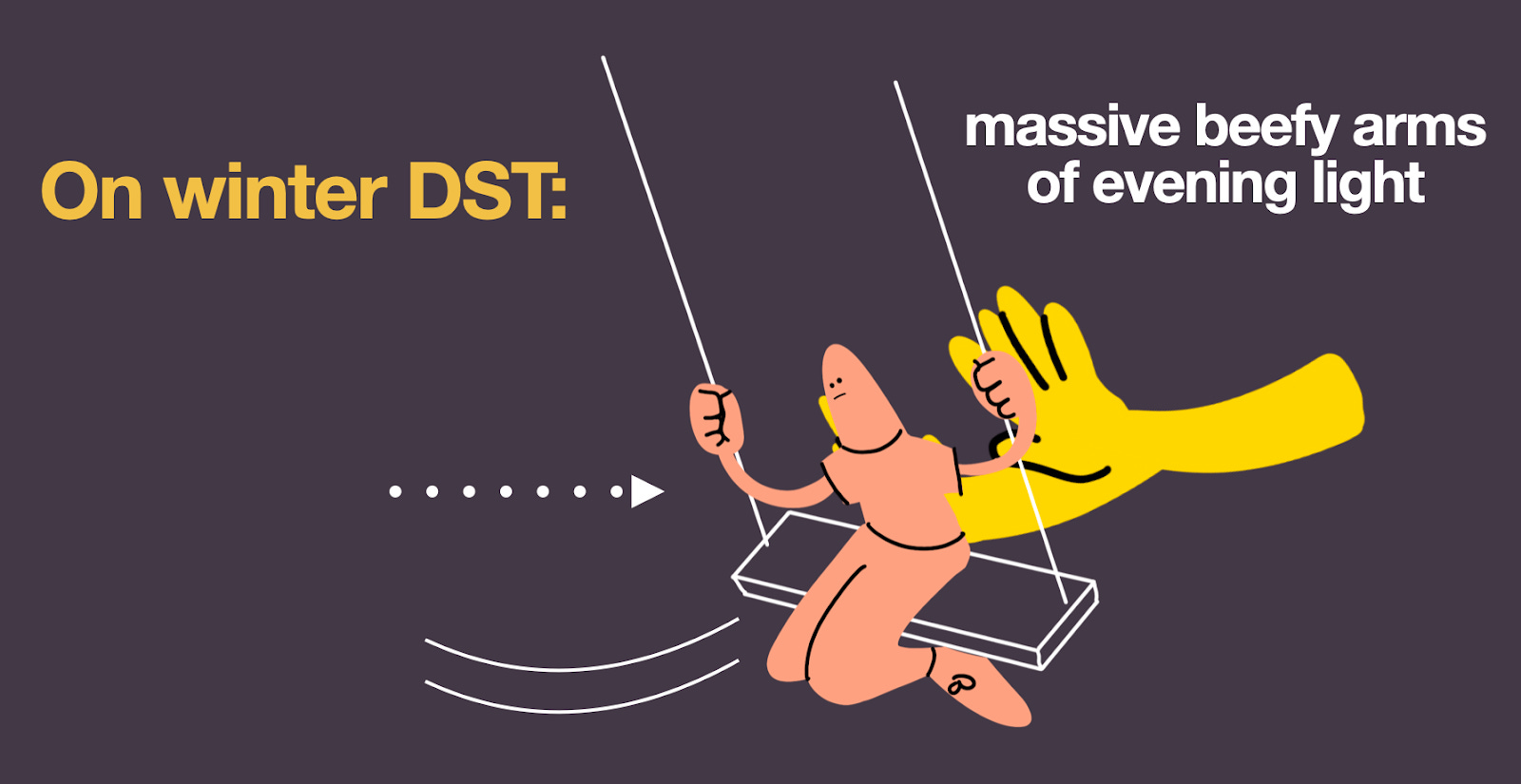
You’d be more robust to that later-in-the-day light if you had morning light to counteract it. But on winter DST, the sun’s just not there when society’s making you wake up and start your day. This imbalance messes up your sleep rhythm (and all the other rhythms in your body as well).
So, in conclusion: Am I sympathetic to people wanting more light during the fun parts of the day? Absolutely I am. But we’re on the cusp of making a policy decision that puts us on either permanent ST or permanent DST. Do we really need to relearn the lessons of all the times permanent DST has failed before, or can we skip that part, and go to the system that Arizona’s had since 1968? Permanent Standard Time, thanks.
My 2026 Review: This one was just me taking umbrage to Nate Silver’s wrong DST analysis (I like him! He’s right about a lot of stuff, just not this!). I’m sure he reads it semi-regularly while sitting in an armchair by his fireplace, holding a wine glass, and simmering with resentment at how good I got him.
Sleeping is like Walking (December 24, 2024)

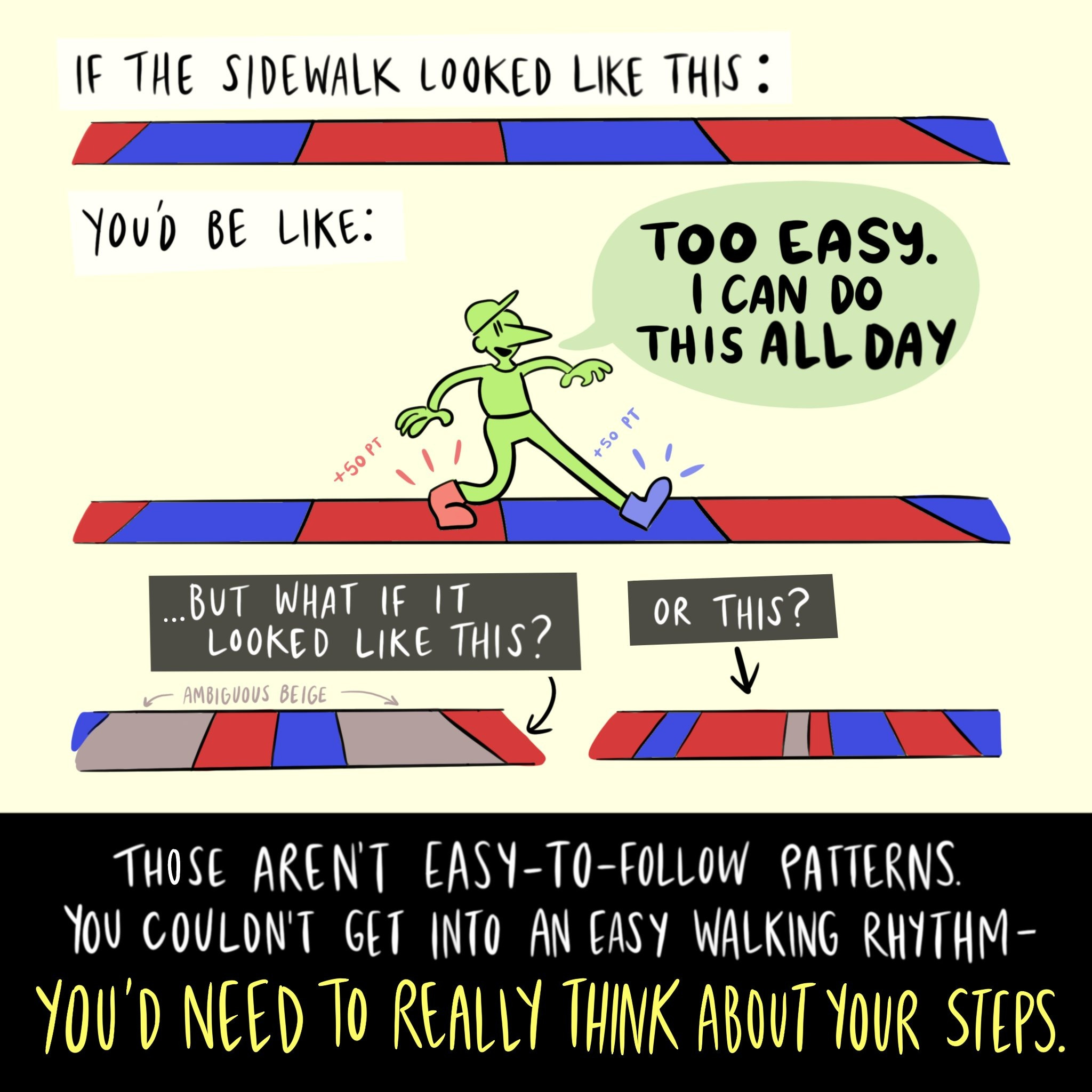
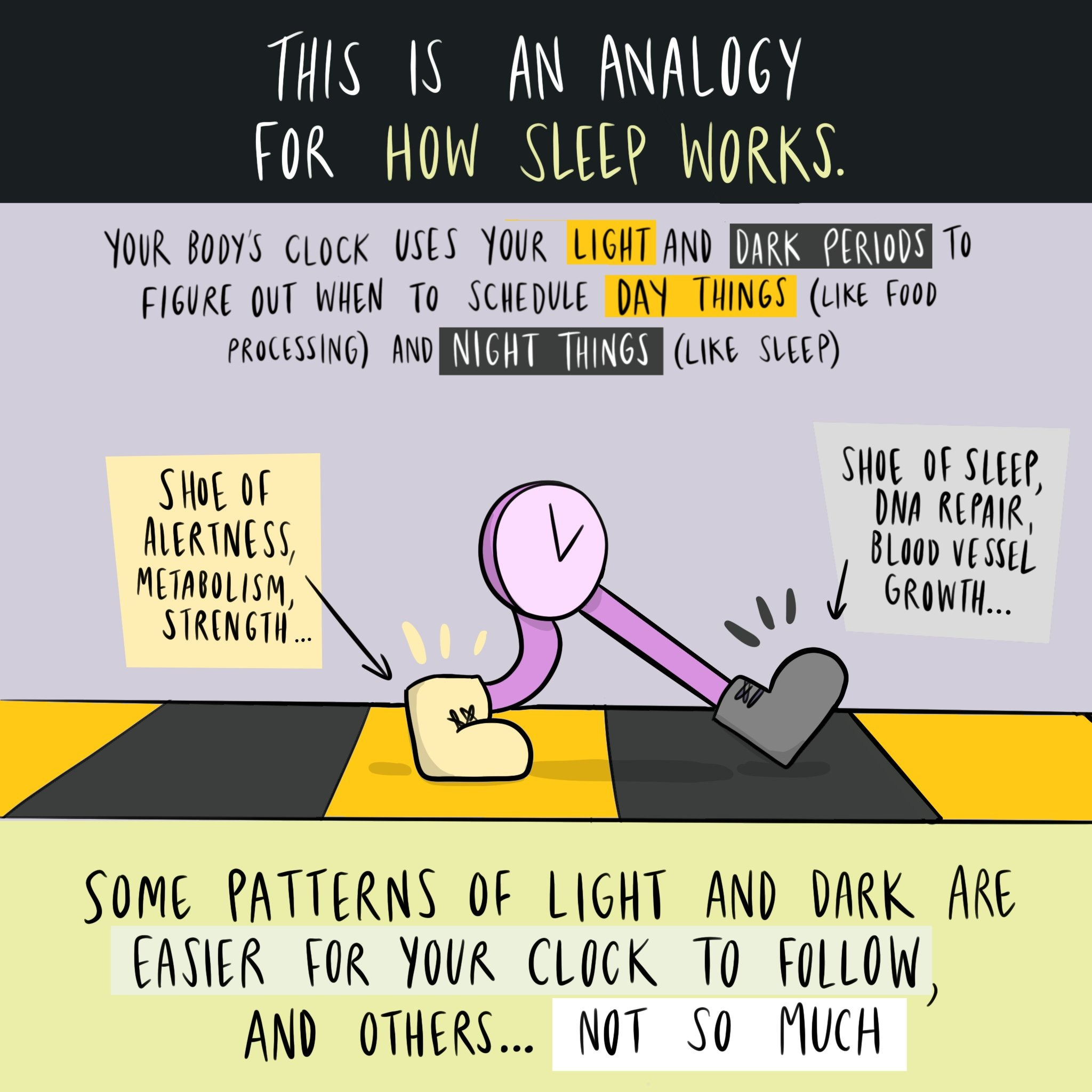
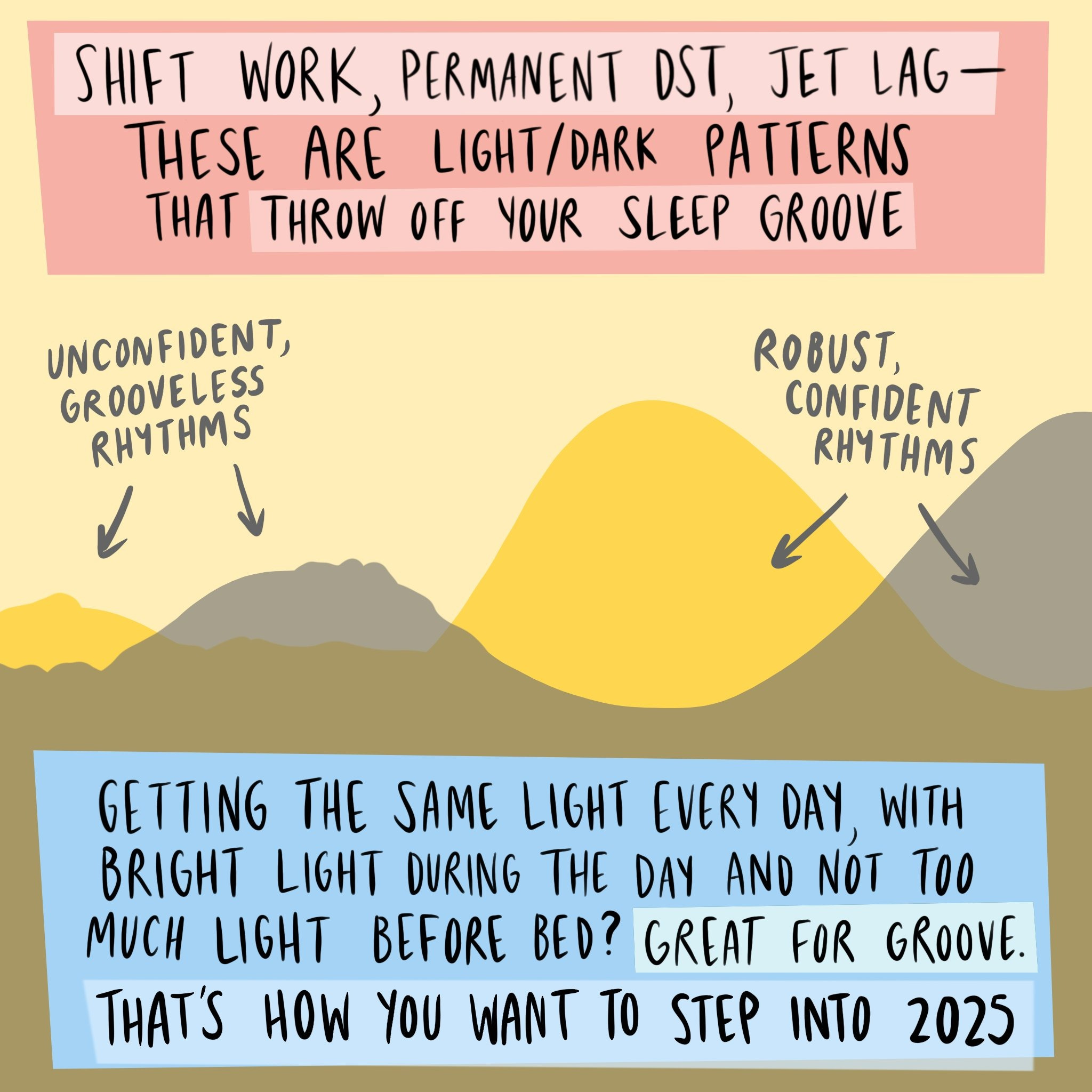
My 2026 Review: I like the analogy between “the unnaturalness of needing to get up for work with dark mornings” and “the unnaturalness of a gait that’s trying to keep in sync with an asymmetric track.” I don’t spell it out in the comic, but permanent DST is like walking on a checkerboard sidewalk where the dark tiles are always a bit too long, so every other step is an uncomfortable stretch. But what was I doing posting this on Christmas Eve 2024. Nate Silver must have really gotten to me that year.