


Basically everyone who’s been alive in winter has had the following experience: You get off work or out of school, step outside, and it’s dark. It’s already dark. It’s cold. You haven’t seen the sun since the morning. You can’t remember the last time you went outside without a coat. You feel like you’re slowly crumpling in on yourself. Your time is finally your own for the day, and you just want to crawl somewhere warm.
And now a less universal experience: You get up early for a flight; super early. You feel wired and empty-headed at the same time. There’s something uncanny about your kitchen when you turn on the lights, like the geometry of your home isn’t quite right. You make it to the terminal and through security and look out the tall windows. The lights overhead are so bright, but the view outside is pitch black. Everything is surreal. You have to look at your phone to get a sense of how long you’ve got before boarding. It could be any time at all.
What I am here to tell you is this: The first one is better than the second one. If you’re going to do something, day in and day out for months, it’s better to have it be dark after work than it is to get up early for the airport. People think they’ll like #2 better because #1 is so miserable, then they don’t. People say they want permanent Daylight Saving Time—the “no more time change” option that makes for bright afternoons and dark mornings—over permanent Standard Time (dark afternoons, brighter mornings), and then they change their mind once they do it for long enough.
Backing up that claim (go ahead, paste this into Claude)
The United States tried and backed off of dark mornings in 1974. Russia tried in 2011 and backed off in 2014. Morocco reverted just this year. Turkey, which has stayed on a relatively mild form of permanent DST (latest Istanbul sunrise: 8:29 AM), still has people writing articles about how much they don’t like it.
Let’s be rigorous. Take all cities of 15,000 people or more. Group them by the time between their latest sunrise and earliest sunset, since that sets the terms of the trade-off between them. Exclude China, where the entire country is on the same time zone, and any place that has changed its winter clock in the last three years (too soon to tell). Across all places that have experienced a dark morning since 1946, how many people are still living under that dark morning today?
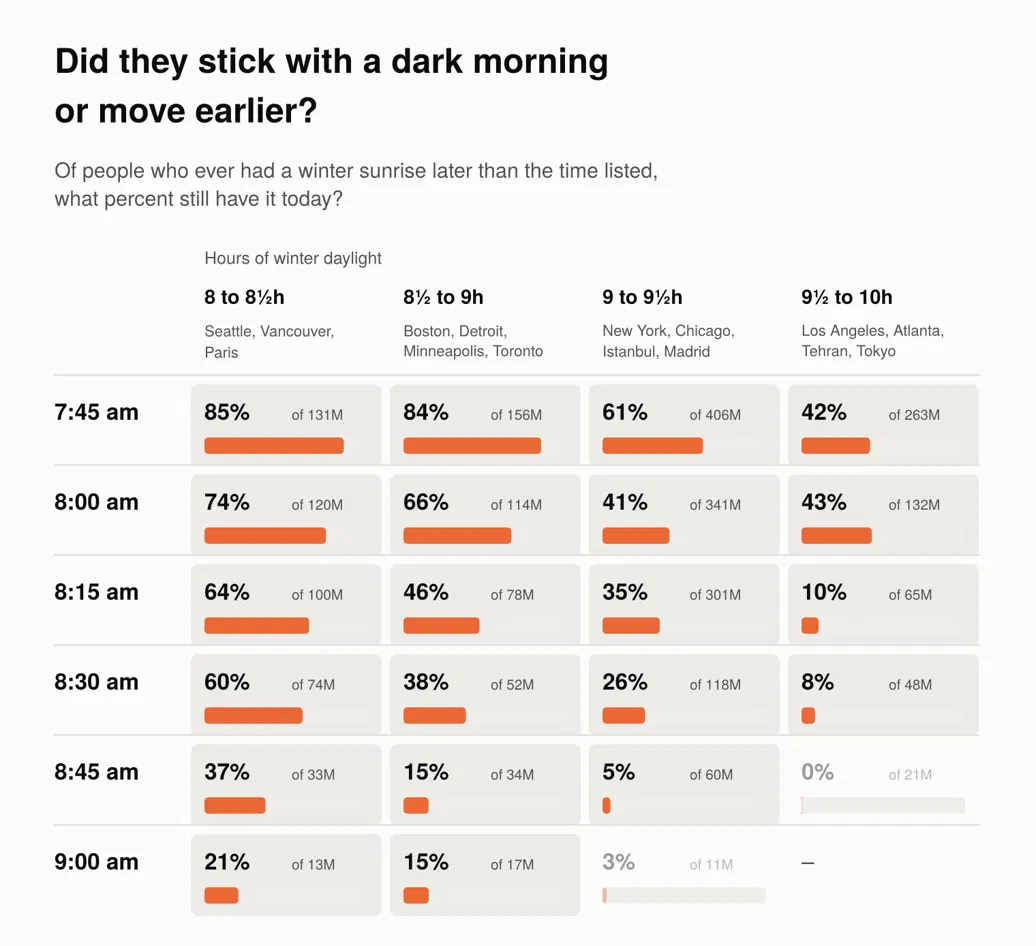
A: If you take a place with a day length like New York’s, and a sunrise like what New York would get on winter DST (~8:19 am), only 35% of people living in places that have experienced that dark morning are still living under it today. As you push the sunrise later, people tolerate it even less. They’re choosing dark afternoons over dark mornings. Why?
The right metric for talking about circadian pain
Wall clock time is a fake social norm. There’s no reason we have to call it noon; we could call it Greg’s Hour if we wanted. We could denote all the times of the day with hieroglyphics and emojis. Daylight Saving Time (DST), being a matter of changing wall clock time, is thus also kind of fake. It’s only an issue because society has conventions, like working nine-to-five, and these conventions have been woven into our collective social fabric, i.e., by Dolly Parton songs. If you could get up and work, shop, live, and hang out with your friends whenever, DST would affect you not at all. It’s only a problem because it creates a tension between solar availability (when the sun is out, providing cheap, free, super bright light) and our social norms around when people work, when stores are open, and when kids go to school.
If you’re going to talk about why one time system—between permanent Standard Time (bright mornings and dark afternoons in winter); permanent Daylight Saving Time (dark winter mornings and bright afternoons); and the current switching system—is worse than any other, you need to make this social inertia central to your argument. DST in the winter isn’t bad because it swaps out one hieroglyph for a different one. It’s bad because social conventions say you need to get on the road for work at 6:30 am, but that’s 1.5 hours before the sun is going to rise. That’s the early trip to the airport; the uncanny time.
The reason early trips to the airport are like that is because you’re getting up and doing things during your body’s biological night, which I’ll define as “the 10ish hour window that starts a couple hours before your normal bedtime.” The right circadian metric to use in talking about how bad the various systems are, I claim, is the overlap between “when you have to be awake and doing things” and this biological night period. If you’ve got more overlap, it’s worse than having less of it.
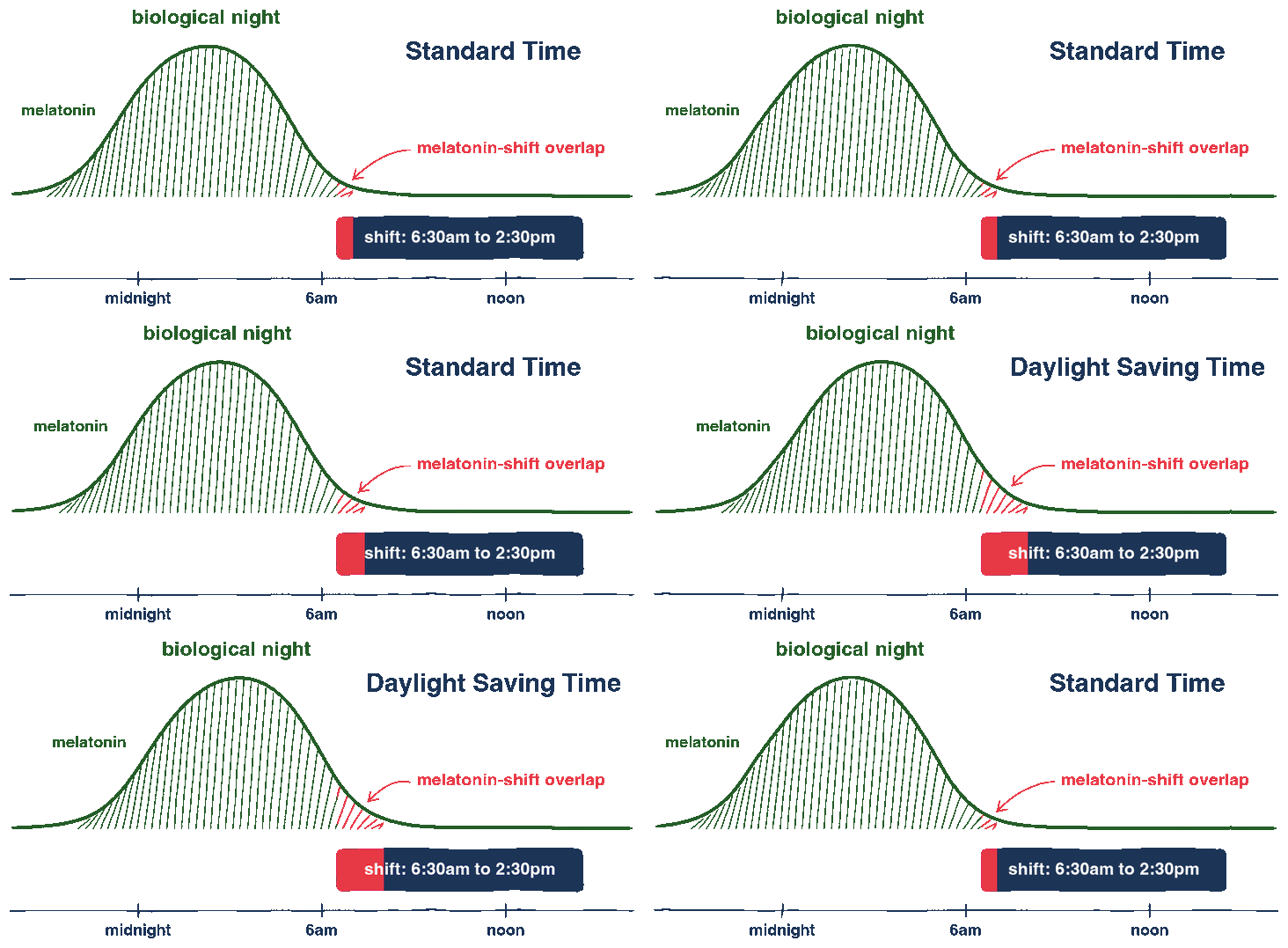
Crucially, biological night and darkness aren’t the same thing. You’re almost certainly not in biological night when you get off work and despair at the fact that the sun’s gone down. Yes, it’s a big bummer. But you’re still in day mode (your body’s set up to think, eat, move), and you will be for a couple more hours at least. For the early trip to the airport, though, you’re absolutely in biological night. If you try to think, the adeptness will be not-quite-there. If you try to eat, your body will fumble the calories.
In a paper-in-progress I call this the “melatonin-shift overlap,” or MSO. It’s the time when your body is in night-mode—that is, when it’s producing melatonin—overlapping with a period of time where you have to be awake and on—a shift. For most of us, our “daily life shift” starts when we need to get up for work or school and ends with the last obligation of our day.
A few worked examples
Let’s say you’re a fairly normal person, and with Standard Time in the winter (the current system), your biological night/melatonin window starts at (say) 8:30 pm. You get up for work at 6:15 am. Ten hours after 8:30 pm is 6:30 am, so you’ve got a 15 minute overlap between the melatonin window and your work shift. Survivable.
Now let’s say we adopt DST for winter. Suddenly, your biological rhythms have shifted relative to wall clock time; let’s say by 50 minutes. Now your melatonin window is starting at 9:20 pm and wrapping up around 7:20 am the next morning. That’s 1.08 hours of overlap (6:15 am to 7:20 am) between your melatonin window and your work shift. You’re waking up with a lot more melatonin in your body. You’re groggy for your commute, your metabolism hasn’t turned on yet, and there’s no jolt of sun to help wake you up. Less survivable. This is what the whole debate is about.
So adopt permanent DST and just move work and school later
That would be the same as adopting permanent Standard Time and moving nothing. Let’s do the one with fewer steps. Or, we could acknowledge that
We have a good compromise now
One thing I like about MSO is that it highlights how our current system is, in the grand scheme of things, fine. It’s a compromise solution. It avoids very late dark mornings in the winter, and lets us have light later in the day when the weather is nice.
Am I, avowed circadian scientist, still team Standard Time all year round? Yes. I see the sun setting at 8:41 pm in June and do a big frowny face in its direction. I hear about my friends having trouble getting their kids to sleep, and I think “ah, of course. DST.”
But I also don’t stress much about melatonin shift overlap during the summer, when DST is active. Because I’m probably not that delayed by the later sun during summer time. The reason isn’t that the sun is any less bright during the summer. It’s that there’s a ton of morning sun during the summer to counterbalance the later evening sun. So the amount my melatonin window shifts in summer will be smaller compared to how much it would shift on winter DST.
Is it still bad to get this later summer light? Yes. Look at people living on the western edges of time zones for proof of this. Is it annoying to switch the clocks twice a year? Of course.
But it’s also clearly liveable. Late winter mornings, the historical record suggests, not so much.
Maybe we just have to experience it to remember
After a bunch of years of fighting about this online, I’m fairly zen about the whole thing. It might just be the case that every generation needs to experience the early-trip-to-the-airport-except-every-day-for-months of permanent DST before we remember why not to do it. It can be a ritual we do every fifty years, as a society: proudly looking back at our forebears and yelling, “you MORONS didn’t know that darkness in the afternoon is BAD, but we GENIUSES will prove it ONCE AND F—oh noooooo.”
Or maybe I’m wrong with all of this, and we’ll try it in the next couple years, and it’ll work out great. “Wow,” I’ll be forced to admit. “It really is worth it to still have the sun up after work.” If I do this, I will post about it, and everyone who’s ever disagreed with me can reply with “L.” I will endure these with dignity.
The thing is, I got up early for a flight a couple weeks ago. I just don’t think it’ll stick.