


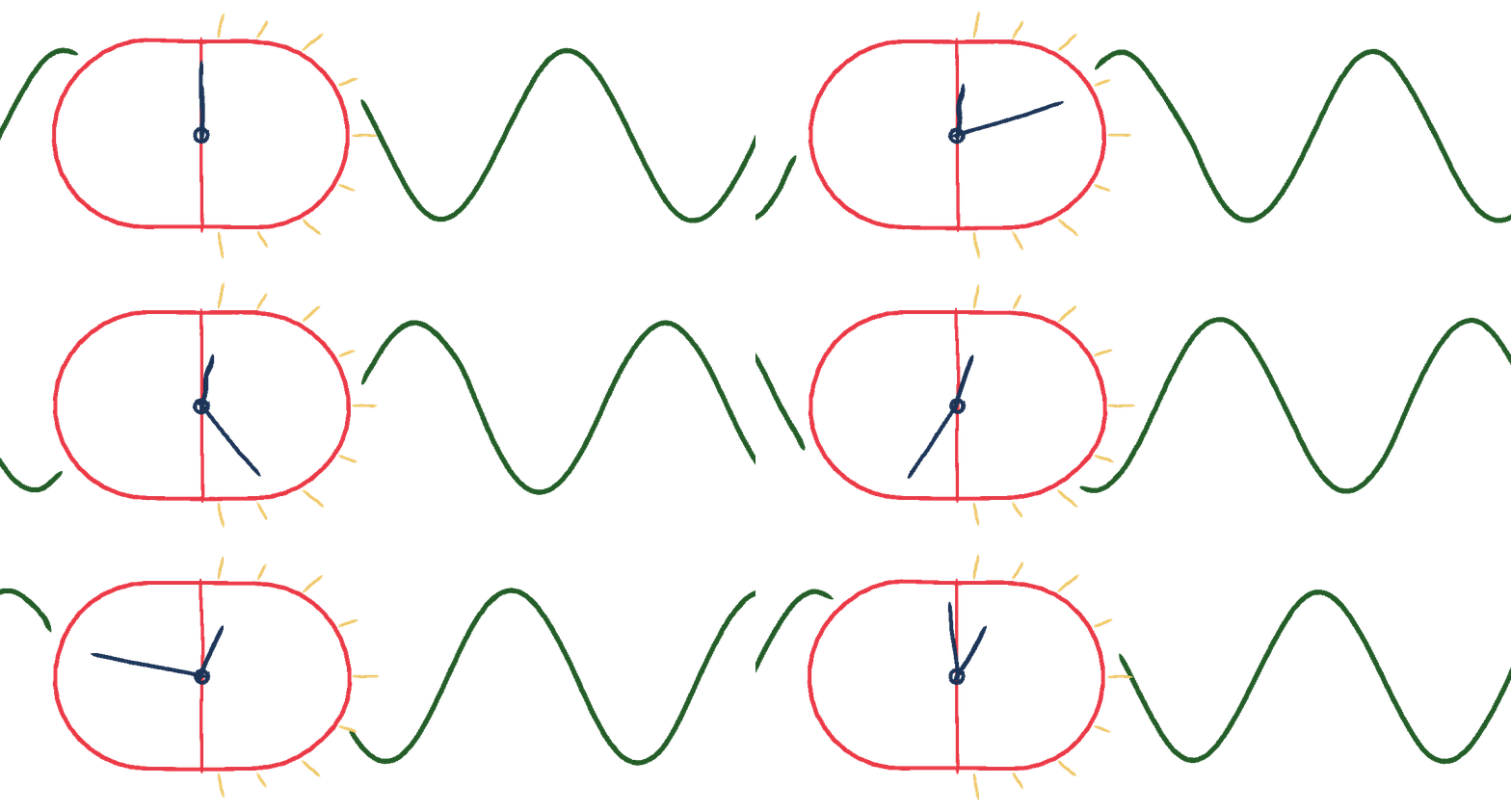
I’m selling caffeine pills to college kids so they can pull all-nighters. Here ya go, buddy, I say, slipping them a blister pack. Pop one of these at breakfast, and you’ll have no trouble staying awake tonight.
The pills have a five-hour half-life. The alerting effect from breakfast is gone by early evening. My customers pass out in their study carrels at 2:00 am, and my caffeine pill business gets a slew of one-star reviews. Bad end.
Now I’m selling melatonin to insomniacs. I’ve made it so easy for you, I assure them. This is a super slow release formulation. Just take it once a month and watch the good sleep roll in.
The pills have a three-week half-life. My customers walk around in a stupor as the night hormone seeps into their system at all hours of the day. “It was better when I wasn’t sleeping at all,” reads one unhappy comment on our product page. Another game over; another bad end.
Where did I go wrong? I forgot time. I told people to put caffeine into their body in the morning when they actually needed it at night. I told people to put melatonin into their body at all times, when they only actually needed it at night.
The first is an example of a treatment that’s mistimed. The second is an example of a treatment that’s mis-designed for the time-sensitive process—sleep—it’s supposed to target.
These examples are silly, of course. For starters, the number of college kids pulling all-nighters to get work done is probably vanishingly small in 2026, unless they’re staying up to keep tabs on thirty-eight Claude agents overnight. And people generally get that sleep drugs, like melatonin, work best if they’re around when you’re sleeping and gone when you’re not.
But people get this because sleep is such an obvious circadian rhythm. You close your eyes, you make your room dark, you put on your Sleepytime Tea Bear costume—it’s impossible to miss that this happens about once a day. Yet there are many, many other circadian rhythms that exist right outside of the periphery of our awareness and play a huge role in how we act, heal, and feel.
You know this already. You know this because you’ve tried to open a jar of jelly first thing in the morning and found it incredibly difficult (musculoskeletal circadian rhythms). You know this because you’ve felt your mucus thicken ominously as night approaches during allergy season (inflammation circadian rhythms). You know this because you’ve thought about your life at 3:00 am and decided you, specifically, were uniquely horrible out of all the people to have ever lived (mood circadian rhythms).
But most non-sleep drugs don’t have much to say on the label about timing apart from “with meals” or “in the morning” with an unspoken “[so you don’t forget, dummy]” tacked on at the end. So why is timing so obvious for sleep and such a non-consideration for everything else?
Yeah, yeah, you say. It’s the title of the blog. Medicine forgot time.
And now, the rug-pull: Medicine didn’t actually forget time. It forgot to come back to it after the challenges of chronomedicine finally became tractable.
A brief history of chronomedicine
Look in the literature for papers on timing drugs, and you’ll notice a certain pattern.
PAPER from GROUP 1: Many have speculated that circadian rhythms in X could affect outcomes in Y. In this work, we sought to understand if treatment with drugs in class Z is modulated by rhythms in X. We compare dosing with Z at 8:00 am to dosing with Z at 6:00 pm and find that outcomes in Y are improved in the 6:00 pm group. We therefore conclude that, for improving outcomes in Y, dosing with Z in the evening is optimal.
PAPER from GROUP 2 (18 months later): no it’s not.
It isn’t actually this bad, but it’s close. Sometimes the data from Group 1 is suspect. Sometimes the critiques from Group 2 are overstated. I’ll be writing about a lot of them here, in future blogs. But if we put aside the universes where all Group 1s are nefarious data fakers or all Group 2s are determined naysayers and assume—as has been the case in my own experience—that people are generally doing their best and acting in good faith, what could explain this disconnect happening as often as it does?
It’s because we’ve been trying to do conceptual surgery while wearing giant, four-fingered Mickey Mouse gloves. We’re brute-forcing things, not finessing them. We’re taking a complex, dynamic strategy game—hitting a moving target in the human body—and button-mashing A and B. Dose in the morning or dose at night.
Sometimes button-mashing works; sometimes it doesn’t. The only way to reliably win is to learn the controls of the game.
So what are the controls?
At its core, the idea I’m talking about boils down to hitting a rhythm that goes up and down once a day with a drug in a way that maximizes or minimizes a desired outcome, like efficacy or toxicity.
Thinking from first principles, what should matter here? For starters, the rhythm itself. Strike when your enemy’s guard is up, and you’re going to be pretty ineffective. Wait until they’re wide open, and it’s a different story.
Two people in the same time zone can have radically different rhythms (shifted ten hours apart from each other, say) by virtue of having different genetics and living on different schedules. Give these two people the same drug at 8:00 am, and you’re hitting their biological rhythms at very different points. One might have a target that’s wide open, while the other is relatively shielded. Average them together and you blunt the effect.
Same goes for rhythm amplitude. People with a flat rhythm will have the same outcome no matter when you dose them. Include enough of those people in your patient population, and you kill the effect size.
Basically no chronomedicine studies control for participants’ circadian rhythms because it’s too hard. The best ones use sleep timing as a proxy, but even that’s a static, imperfect approximation that ignores amplitude.
What else matters? How about the pharmacokinetics and pharmacodynamics (PKPD) of the drug? A drug with a 6-hour half-life will have a different best time than a drug hitting the exact same target with a 12-hour half-life. Not to mention the time until peak, or the more complicated dynamics of how byproducts of the drug decay and are sequestered.
Drug interactions matter. Someone on a CYP inhibitor won’t have the same PKPD as someone not on one. Someone taking dexamethasone might have their circadian rhythms scrambled—or have negative consequences from the dexamethasone mask positive outcomes from optimal timing of a different drug. If one drug is best in the morning and the other is best at night, and you take both of them at the same time, you’ve (once again) blunted any effect you could hope to observe.
Drug metabolism matters—rhythms in the liver can gate what gets through to the rest of your body. Meal interactions matter. Sex matters. Dose matters. Different amounts of a drug can make for different best times. No one talks about this! It matters! No wonder different groups get different answers!
And there’s absolutely nothing at all in biology that says a best time has to be morning or night.
A treacherous landscape stretches out before you. The ground is composed of shifting blocks, meteors rain down from on high, pillars of lava surge up at random intervals. If you can just keep track of all the moving pieces and get to the other side, you win.
You gaze out upon it all, lit from below by the flames, face impassive.
Then: A A A A A A A B B B B B B B A A A A A A A A A A
Despair, despair
The reason we don’t just try all possible times in drug development is that it’s too expensive—nobody wants to multiply the costs of a clinical trial by 2, 12 or 24. Not to mention the fact that circadian rhythms are dynamic and mutable, making it so the best time for a drug technically depends on the circadian state of the person taking it in the moment they take it. Combine that with everything I mentioned above, and it’s easy to be a pessimist. Why bother thinking about time at all? Keeping track of everything will take, frankly, a lot of math. It’s never going to be worth the work.
If you’d said that in 1999, or 2010, or 2020, then okay, sure. Keeping track of everything would take a lot of math. I came of age in an era where much of computational biology’s cutting edge lived in folders of MATLAB scripts maintained by grad students. You had to squint a bit to see the latent explosive potential in files like runSodiumChannel4.m.
But we live in 2026
The nice thing about living in the future is that you sometimes get to do futuristic-sounding things. In my case, at my company, Arcascope, this is building digital twins— combinations of equations and data that attempt to, in real time, tell us more about what’s going on inside the body than we can figure out from data alone.
There are many ways to put digital twins to work; chronomedicine, to me, is the best and most obvious one. If the field has been held back by a lack of specificity—in how we talk about the notion of a best time, in how we attempt to study it—then digital twins, which replace words like “we need to consider the role of CYP3A4” with equations that do exactly that, are clearly part of the solution. Deep digital twins; ones that grow and evolve over time with new experimental data, new structural insights, and new forms of input.
A phrase I love, but that lands differently depending on the audience, is that chronomedicine is “Medicine in the Fourth Dimension.” As in: You’ve heard of x, y, and z as the spatial dimensions—now here’s TIME with the STEEL CHAIR. To me, adding a new dimension speaks of near unimaginable potential, blasting open the realm of the possible. An entirely new dimension to add to our definition of a therapeutic window. Something that can illuminate muddled or confusing data into a clear, mechanistic, time-dependent story. Remember the fake super-long-acting melatonin pill from the top? How many real therapies have been done in by off-target effects because they flooded the system with a drug when they should have pulsed it? How much more can we learn and build when we bring time into the picture?
But it can also come across as a bit… same-old. Time’s not a sexy new drug or delivery mechanism. Time’s been here this whole time. Haven’t you guys figured Time out already?
We haven’t. We forgot about it because it was hard and expensive and inconsistent, and it was easier to wave it away as irrelevant because the effect sizes couldn’t possibly justify the effort. But a caffeine pill at the wrong time isn’t “10% less effective”, it’s useless. And there are problems out there (real problems, persistent problems, time-relevant problems) with much higher stakes than “I want to stay up late.” Your brain cancer treatment might be twice as effective if you dose in the early morning. Your diagnosis might be time-dependent. And these findings are just from papers I’ve got a personal connection to—there are lots and lots of great people out there doing great science in this space.
We’re only just now scratching the surface. Time to get to work.
Love this, this topic fascinates me, and when I've tried to find quality research, I ran into the exact issues you discussed.
Incredible insight—the MILO trial comes to mind